
Reviewed · CHENGDU TOURS
Half-Day Walking Tour with a Vegetarian Lunch at a Nunnery
Chengdu’s best food lessons often happen away from restaurant tables. This half-day walk takes you through a local spice market, where you learn about Sichuan ingredients and try traditional snacks, then leads you to a nunnery vegetarian lunch with a Buddhist ceremony.
I like the direct look at the ingredients behind Sichuan cooking, and I like the gentle change of pace from market stalls to temple rooms and tea. The main consideration is that the tour is listed as a small-group experience but also gives a maximum of one traveler, so confirm the group setup when booking.
Key Points
- Sichuan spices up close: Explore a working local market and learn how ingredients shape the region’s famous cuisine.
- Vegetarian nunnery lunch: Take part in a special Buddhist lunch ceremony rather than simply eating at a standard restaurant.
- Back-street Chengdu: Walk between the market, nunnery, tea house, and Wenshu Monastery to see a less polished side of the city.
- Wenshu Monastery finish: End at Chengdu’s oldest temple, with about two hours of the experience connected to the monastery visit.
- Personal guide service: The tour is designed for a very small group, with hotel pickup available inside Chengdu’s second ring road.
- Good food and culture value: At $50, the price covers snacks, lunch, tea, water, a guide, and transportation from qualifying hotels.
Why This Chengdu Walk Feels Different
Many Chengdu food outings focus on ordering a long list of dishes. This one takes a wider view. You begin with raw ingredients in a spice market, then follow the food into a religious setting where vegetarian cooking is part of a Buddhist ritual.
That makes the experience useful if you want to understand why Sichuan food tastes the way it does, not just sample a few finished plates. Your guide helps identify spices and ingredients, explains their role in local cooking, and gives you small tasks to make the market visit active rather than passive.
The tour also moves through back streets on foot. That matters. You get a sense of how the city connects its food markets, neighborhood lanes, temples, and tea houses. This is not a sightseeing route built around major monuments alone. It is a food and culture walk with Wenshu Monastery as its most recognizable stop.
The experience runs for about four to five hours and begins at 9:00 a.m. That is a useful length for a morning activity, leaving you much of the day for pandas, museums, or another Chengdu neighborhood.
More vegan and vegetarian food in Chengdu:
- Half-day Private Panda Tour with Vegetarian Lunch in Nunnery
★ 5.0 · 8 reviews - Shanghai-Cooking Dumpling & Meal in Local Family-w/Vegan
★ 4.9 · 36 reviews - Vegan Soup Dumpling Making in Shanghai
★ 5.0 · 17 reviews
Starting at Wenshu Monastery and the Spice Market
The stated meeting point is Wenshu Yuan Monastery at 66 Wen Shu Yuan Jie. The tour may also include hotel pickup and drop-off if your hotel is within Chengdu’s second ring road. Confirm the pickup arrangement before setting out, since the listed start point and hotel service are both part of the operation.
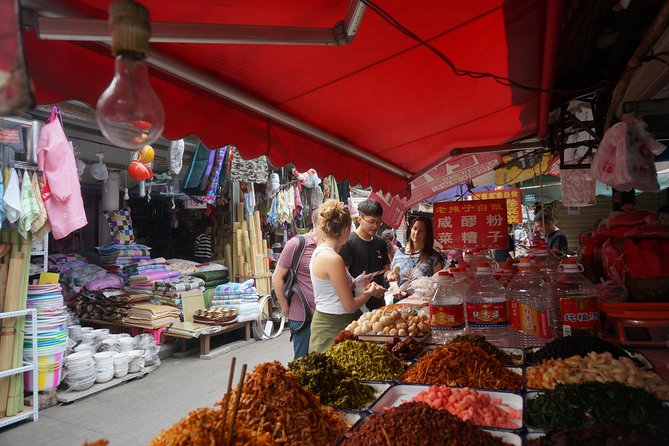
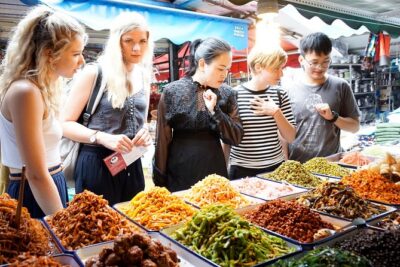
From the meeting area, your guide takes you toward the local spice market. The market is the heart of the food portion of the tour. Instead of meeting Sichuan cuisine only as a finished bowl of noodles or a plate of mapo tofu, you see the spices and ingredients that build its flavor.
You can expect explanations about different Sichuan spices and how they are used in regional cooking. The supplied description does not promise a fixed list of ingredients, so the exact selection may vary with the market and season. That is part of the appeal, but it also means you should not book this expecting a tightly scripted cooking class.
The market visit includes food tasting. Traditional snacks are part of the route, giving you a chance to try items you might overlook when ordering from an English-language menu. Your guide can also help make sense of unfamiliar products and answer questions as you go.
One particularly useful detail is the assigned-task format. You are not just led past stalls while someone talks. The guide sets small things for you to try and learn, which can make the visit more memorable and easier to follow.
A market is also a working place, not a museum. You should dress for walking and changing conditions, since the tour operates in all weather. Comfortable shoes matter more than stylish ones, and a light rain layer is sensible if the forecast is uncertain.
Walking Through Chengdu’s Back Streets
After the market, the route continues on foot through back streets toward a nunnery. This is where the tour shifts from food orientation to neighborhood exploration.
The distance and exact streets are not specified, so you should not treat this as a measured walking workout. Still, the experience is built around seeing Chengdu at street level. You move between ordinary city spaces rather than spending the whole morning inside formal attractions.
I like this section because it gives the day a natural rhythm. The market is noisy and practical. The back streets offer time to absorb what you have seen before reaching the quieter religious setting.
The walk also makes the lunch feel connected to the rest of the morning. You have already learned about Sichuan ingredients, and now you encounter food in a setting shaped by Buddhist practice. That connection is more interesting than a simple market visit followed by lunch in an unrelated dining room.
The tour is described as suitable for most participants, with a minimum age of five. Children must be accompanied by an adult. Because this is a walking tour lasting several hours, families should consider whether younger children can manage the pace and food-focused stops, even though the published minimum age is five.
The Nunnery’s Vegetarian Lunch Ceremony
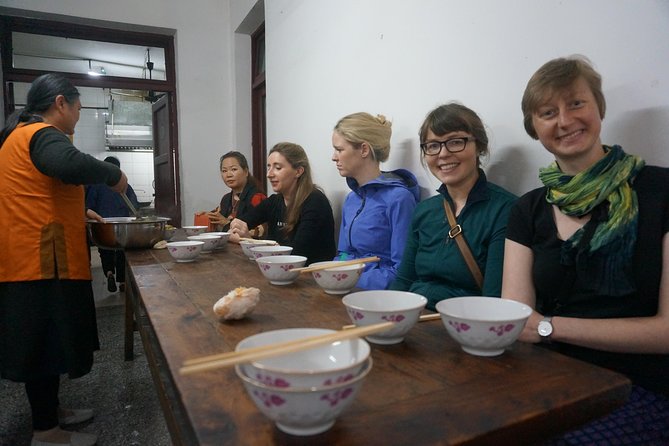
The nunnery is the most unusual part of the experience. You do not simply stop for a vegetarian meal. You are there for a special Buddhist ceremony connected with lunch.
The ceremony offers a glimpse of religious practice in a way that a quick temple photo stop cannot. You should approach this part with quiet attention and respect. The schedule does not specify how long the ceremony lasts or what participation involves, so your guide will be your best source of instructions on the day.
Lunch is included in the $50 price. Since the meal is vegetarian and served at a nunnery, it is also a practical choice for anyone who wants to try Buddhist temple cuisine. The information provided does not list individual dishes or confirm how the food is served, so avoid booking with expectations of a particular menu.
This setting may be especially appealing if you have already seen Chengdu’s popular food streets and want something less commercial. The meal is not presented as a luxury dining experience. Its value comes from the setting, the ceremony, and the chance to see how food fits into a religious community.
If you have dietary needs beyond vegetarian food, ask before booking. The available information confirms a vegetarian lunch, but it does not provide details about vegan options, allergies, gluten, or ingredient substitutions.
The nunnery stop is also the point where the tour asks for good cultural manners. Keep your voice low, follow the guide’s instructions, and treat the ceremony as a living practice rather than a performance arranged for visitors.
More lunch stops in Chengdu:
- Dujiangyan Panda Volunteering Experience with Lunch
★ 5.0 · 66 reviews - Chengdu Private Day Tour to Emei Mountain with Lunch and Cable Car Ride
★ 4.5 · 6 reviews - Day tour Chengdu Panda Base Leshan Giant Buddha with local Lunch
★ 5.0 · 5 reviews - Beijing: Mutianyu Great Wall Daily Tour with Ticket & Lunch
★ 5.0 · 3,056 reviews
Tea in an Authentic Chengdu Tea House
Tea is included as afternoon tea, with coffee and tea also listed among the inclusions. The route describes a stop at an authentic local tea house after the nunnery visit.
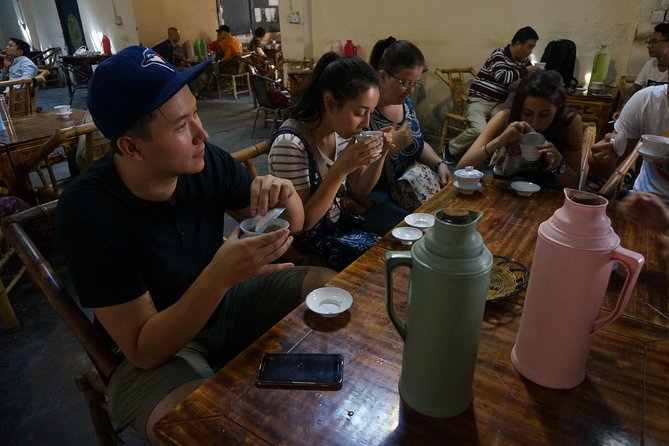
This break gives you a chance to sit down after the market and walking sections. It also adds a distinctly Chengdu touch. Tea houses are closely tied to the city’s social life, and a tea stop helps show that the city’s food culture is not only about heat, pepper, and quick meals.
The exact tea house, drink, and length of the stop are not specified. Think of it as a cultural pause rather than a formal tea tasting. Bottled water is included too, which is useful on a warm day or during a longer walk.
I would treat the tea stop as one of the tour’s small but important details. Without it, the morning could feel like a chain of food samples and temple visits. With it, you get a moment to talk with your guide, ask about Chengdu customs, and take stock of what you have seen.
Wenshu Monastery as the Final Stop
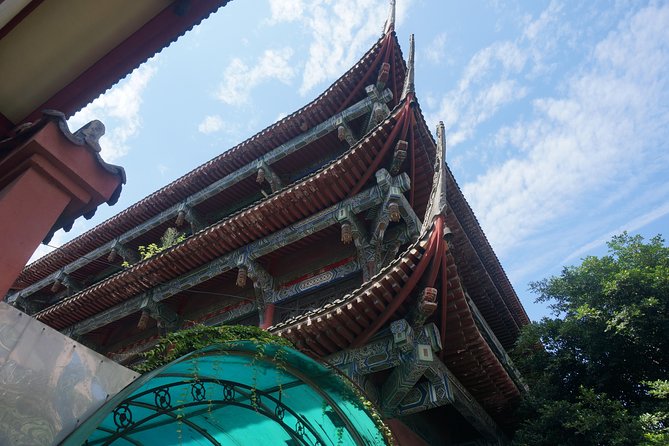
The tour ends back at Wenshu Yuan Monastery, also known as Wenshu Monastery. The route description presents it as the oldest temple in Chengdu and allows about two hours for the monastery portion of the experience.
Because the meeting point and ending point are the same, this is convenient if you are staying nearby or plan to continue exploring the area afterward. It also gives the tour a clear anchor. You begin and end around one of Chengdu’s major Buddhist sites while spending the middle of the morning in markets, lanes, a nunnery, and a tea house.
The monastery is not treated as an isolated monument. It serves as the final piece of a day that has already introduced you to Buddhist food and ceremony. That gives the visit more context than arriving only to take photographs.
The details of the monastery commentary are not listed, so the depth of the visit may depend on your guide. The tour is conducted with an English-speaking local guide, and the experience is intended to be informative and personal. If Wenshu Monastery is your main priority, ask how much time will be spent on the grounds and what the guide plans to cover.
Guide Style and Group Size
The tour is built around a personalized format. It is described as a small-group walk, yet the additional information gives a maximum of one traveler. That wording suggests the experience may operate as a private or near-private outing, but you should confirm this directly with Chilli Cool China.
A one-person booking can be a real advantage. You can ask more questions at the market, move at a comfortable pace, and spend more time on the parts that interest you most. Families and couples may also appreciate a guide who can adjust explanations to their interests.
One guide named in the tour material is Winter. A published account describes Winter picking up a visitor from a hotel and taking them directly to a local wet market, where he answered questions and explained what was on display. That detail gives you a useful idea of the guide’s role: not just leading the route, but helping you read the market.
Lance is identified as part of the Chilli Cool team in the provider’s response, but the guide assigned to your date may be someone else. Confirm the name and pickup details if personal service is important to you.
Is $50 a Fair Price?
At $50 per person, this is not the cheapest way to walk around Chengdu. You are paying for more than a market visit, though. The price includes food tastings, lunch, bottled water, tea or coffee, afternoon tea, an English-speaking guide, and hotel pickup and drop-off within the second ring road.
The value depends on what you want from a half-day. If you only want to browse a market, you could spend less on your own. You would not get the same help identifying ingredients, the organized snack tastings, the nunnery ceremony, the included vegetarian lunch, or the guided connection between the food and religious stops.
The price makes more sense for a first visit to Chengdu, especially if you are unsure how to approach a local market or religious site. It also suits visitors who prefer one well-shaped morning instead of planning several separate stops.
The experience is currently rated five out of five from six published ratings, which supports the idea that its personal and unusual format is the main selling point. That is a small sample, so I would treat it as encouraging rather than final proof. The strongest reason to book is the unusual combination of market, Buddhist lunch, tea, and monastery, not the rating alone.
Who Should Book This Experience?
I would recommend this walk to you if you enjoy food with context. You should be curious about spices, open to unfamiliar snacks, and interested in seeing how Buddhist practice shapes a meal.
It is also a good fit if you have already visited Chengdu’s major attractions and want a quieter, more personal morning. The back-street walking and tea stop add local texture without requiring a full day away from the city.
Families can book for children aged five and above, provided an adult accompanies each child. Still, the religious ceremony and several hours of walking may suit older children better than very young ones.
You may want to skip it if you are looking for a cooking lesson, a restaurant crawl, or a large list of famous Sichuan dishes. The food is important, but the focus is on ingredients, snacks, temple cuisine, and culture rather than a full meal-by-meal survey of Chengdu cooking.
You should also think twice if you dislike early starts. The meeting time is 9:00 a.m., and the schedule is structured around a morning market visit followed by lunch and temple stops.
Practical Details Before You Go
The tour lasts about four to five hours and operates in all weather. Wear comfortable walking shoes and dress for the forecast.
Mobile tickets are provided. Confirmation is received at booking, and the experience is near public transportation. Hotel pickup and drop-off apply to hotels inside Chengdu’s second ring road, while the stated meeting point is Wenshu Yuan Monastery.
Free cancellation is available if you cancel at least 24 hours before the 9:00 a.m. start time. Changes or cancellations inside that window are not accepted for a refund, and cut-off times use Chengdu local time.
The tour is offered by Chilli Cool China. Since the capacity information says a maximum of one traveler, confirm whether your booking will be private, especially if you are traveling as a couple or family.
Should You Book the Chengdu Nunnery Lunch Walk?
Book it if you want a morning built around real food culture and Buddhist tradition, not just a checklist of Chengdu sights. The spice market, snack tastings, nunnery ceremony, vegetarian lunch, tea house, and Wenshu Monastery make a thoughtful route through several sides of the city.
The best fit is a curious eater who values a personal guide and does not need a fixed menu or polished tourist setting. At $50, the package offers solid value when you count the lunch, tastings, tea, water, guide, and eligible hotel transport.
Skip it if you want a fast-paced food crawl, a cooking class, or detailed guarantees about specific dishes. For everyone else, this is one of the more distinctive half-day ways to connect Chengdu’s food stalls, quiet religious spaces, and neighborhood streets.
FAQ
Where does the tour start?
The stated meeting point is Wenshu Yuan Monastery at 66 Wen Shu Yuan Jie in Chengdu.
What time does the tour begin?
The tour starts at 9:00 a.m.
How long does the experience last?
It lasts approximately four to five hours.
Is hotel pickup available?
Hotel pickup and drop-off are included for hotels within Chengdu’s second ring road.
What food is included?
The experience includes food tastings, traditional snacks, a vegetarian lunch at a nunnery, afternoon tea, and coffee and/or tea.
Is bottled water included?
Yes, bottled water is included.
Is the tour suitable for children?
Children must be accompanied by an adult, and the minimum age is five.
Does the tour operate in bad weather?
Yes. It operates in all weather conditions, so you should dress appropriately.
How large is the tour group?
The experience is described as a small-group tour, while the additional information lists a maximum of one traveler. Confirm the expected group size with Chilli Cool China.
Can I cancel for a full refund?
Yes, if you cancel at least 24 hours before the experience start time. Cancellations or changes made less than 24 hours in advance are not accepted for a refund.
More half day trips in Chengdu
- Half-Day Chengdu Cooking Class with a Local Market Visit
★ 5.0 · 465 reviews - Private Half-Day Chengdu Panda Breeding Center Tour with Optional Volunteer
★ 5.0 · 353 reviews - Half-Day Chengdu Back Alley Foodie Tour
★ 5.0 · 58 reviews - Half-Day steamed Buns Cooking Class with a Local Market Visit
★ 5.0 · 26 reviews
More Walking Tours in Chengdu
- 6-Hour Private Chengdu City Walking Tour with Tea Tasting
★ 4.5 · 10 reviews - Beijing Hutong Walking Food and Beer Tour at Hidden Restaurants
★ 5.0 · 1,132 reviews - Hong Kong: Dark Side of Hong Kong Caged Homes Walking Tour
★ 4.8 · 790 reviews - Private Beijing Walking Tour of the Forbidden City with 7 Options
★ 5.0 · 675 reviews
Recently listed in Chengdu
- Full-Day Tour of Leshan’s Giant Buddha from Chengdu★ 5.0 · 5 reviews
- Unique One-Day Tour: Interactive Experience with Red Pandas★ 5.0 · 5 reviews
- Chengdu Nightlife Experience with a Local: Bars, Clubs & Culture★ 5.0 · 5 reviews
- Half-Day Tour at Chengdu Panda Breeding Research Base★ 4.0 · 5 reviews
- Private Day Tour: Dujiangyan Panda Base Volunteering from Chengdu★ 4.0 · 5 reviews
- Private Day Tour: Chengdu Panda and Leshan Buddha★ 4.0 · 5 reviews
- One Day Giant Panda Leisure Private Tour in Chengdu★ 5.0 · 5 reviews
- Chengdu: Giant Panda Base Reservation and Entry★ 5.0 · 5 reviews
Chengdu Tours, compared.

Half-Day Chengdu Cooking Class with a Local Market Visit
Read our review →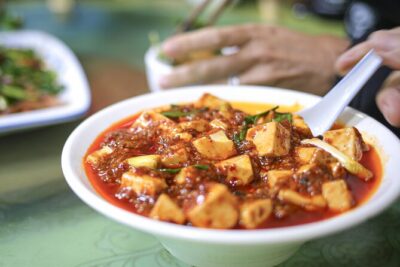

Private Half-Day Chengdu Panda Breeding Center Tour with Optional Volunteer
Read our review →
Sichuan Opera Shu Feng Yan Yun Evening Show Ticket
Read our review →
Private Chengdu Day Tour: Giant Pandas and Jinsha Site Museum
Read our review →
Visiting Dujiangyan Yaan Wolong Panda Base Optional Volunteering
Read our review →
Chengdu Sichuan Opera Show Ticket – Shu Feng Ya Yun
Read our review →Browse the lists this tour appears in