
Reviewed · YU GARDEN TOURS
Shanghai: Yuyuan, City God Temple Old City Tour-Tip Based
Shanghai’s old city packs a lot into a few lanes. This two-hour walk takes you from Yuyuan Old Street to the City God Temple, then through gardens, market lanes, Chinese medicine, and a quiet park. It is a useful way to see how Shanghai’s modern city grew around older homes, temples, shops, and local customs.
I like the focus on Taoist and folk traditions, not just architecture. I also like the small-group size, capped at 10 people, and the chance to ask for personal Shanghai tips. The main drawback is the brisk schedule: several stops receive only 20 minutes, and the route includes uneven walking that may not suit anyone with mobility problems.
Key points
- City God Temple in context: Learn how Taoism, folk religion, gods, rituals, and seasonal celebrations shape local culture.
- A taste of Chinese medicine: Visit Tonghan Chuntang and sample the so-called king of herbs.
- Zodiac stories with costumes: Explore the 12 Chinese zodiac animals through a colorful cultural display.
- Garden views without a long commitment: See the 9 Zig-Zag Bridge and Mid-Lake Pavilion area in a compact visit.
- Local advice from an English-speaking guide: Guides such as Jie offer restaurant, sightseeing, and neighborhood suggestions.
- A tip-based price: The listed price is about $2.36 per person, but you should treat the experience as tip-based rather than a standard fixed-price tour.
Why this short walk works in Shanghai
Yuyuan is one of the easiest places in Shanghai to feel the city change under your feet. One minute you are among restored traditional-style buildings, souvenir stalls, and temple crowds. A few steps later, you are looking at old lanes, garden walls, medicine shops, and traces of everyday life in the ancient city.
The tour is built for first-time visitors who want a cultural introduction without giving up half a day. In two hours, you get a guide to the area, a look at Taoist customs, a few garden landmarks, and practical advice for the rest of your stay.
I would not book this as a slow garden tour. It is better understood as a guided orientation walk with several focused stops. You will see the main points of interest, hear the stories behind them, and leave with a better sense of where to return on your own.
The tour runs in English and uses a small group of no more than 10 people. That matters here. Yuyuan can be crowded, and a large group would make it harder to hear explanations or gather around a shrine, shop, or narrow lane.
More Yu Garden visits:
- Best of Shanghai Day Tour, including Jade Buddha Temple & Bund & Yuyuan Garden
★ 4.0 · 338 reviews - Shanghai: Yu Garden Admission Ticket
★ 4.6 · 260 reviews - Yu Garden, Old Street, Bund & Zhujiajiao Water Town Bus Tour
★ 4.7 · 244 reviews
Meeting at Yuyuan Garden Station
The meeting point is at Yuyuan Garden metro station Exit 1, served by Metro Lines 10 and 14. Look for the red umbrella. The address in Chinese is 豫园, 1号出口, 上海市黄浦区.
There is a small inconsistency in the supplied details: the itinerary also names Exit 3 as a starting location. I would follow the specific confirmation you receive after booking, and if in doubt, use Exit 1 and look for the red umbrella as instructed. Showing the Chinese address to a taxi driver is the safest option.
Arrive ready to walk. Comfortable shoes are not just a polite suggestion here. The route passes through old streets, temple grounds, garden paths, and market areas, where surfaces may be uneven and foot traffic can slow you down.
Keep your wallet, phone, and passport secure. The tour takes place in busy public areas, and the instructions specifically warn you to protect personal belongings. Smoking is not allowed during the activity.
Yuyuan Old Street and the changing old city
The first substantial stop is Yuyuan Old Street, with about 30 minutes of guided explanation. This is where the tour begins to explain Shanghai as a place of changing homes and changing habits, rather than just a collection of pretty buildings.
You will hear about the ancient city and how residents’ living spaces have shifted over time. That context helps you read the streets. Traditional-looking facades may now hold shops, food stalls, or visitor businesses, while older lanes reveal how closely daily life once fit around temples, markets, and family homes.
The area is also a good place to orient yourself. You may see small goods, food, souvenirs, and local craft items as the route moves on. The guide’s job is especially useful here because it can be hard to tell which details are old, which are restored, and which are aimed mainly at shoppers.
The trade-off is crowding. Yuyuan Old Street is not a quiet museum. If you want clean photographs or a calm look at every storefront, two hours will feel rushed. If you want a lively introduction to the district, the movement and noise are part of the setting.
Twelve zodiac animals and everyday Chinese beliefs
One of the more unusual elements is an introduction to the 12 Chinese zodiac animals, each shown with its own costume. This gives the tour a lighter, more personal angle than a standard temple lecture.
Your guide can connect the animals with common beliefs and the way people use zodiac signs in everyday conversation and celebration. You will have a chance to identify your own sign and consider how these traditions fit into Chinese culture.
This is a good stop for families and for anyone who wants a simple entry into a subject that can otherwise seem complex. The costumes also give you something visual to remember, rather than a list of dates and names.
Keep in mind that the zodiac section is part of a moving walking tour, not a long specialist talk. You will get an accessible introduction rather than a detailed study of Chinese astrology.
A few more Shanghai days to line up
- Authentic Local Food Tour in Central Shanghai
★ 5.0 · 1,382 reviews - Zhujiajiao Water Town and Shanghai City Private Day Tour
★ 5.0 · 1,016 reviews - Private Shanghai Full Day City Tour with Old and New Highlights
★ 5.0 · 995 reviews - Shanghai: Hop-on Hop-off Bus Ticket and Optional Attractions
★ 3.4 · 692 reviews
Tonghan Chuntang and the king of herbs
The visit to Tonghan Chuntang lasts about 20 minutes and introduces traditional Chinese medicine. You will step into a traditional medicine shop, hear about medicinal herbs, and sample the substance described as the king of herbs.
This is one of the tour’s most hands-on moments. Instead of only looking at temple roofs and old streets, you get a direct encounter with a practice that remains part of Chinese cultural life. The guide can explain how the shop fits into the area and why certain herbs carry such importance.
I would approach the tasting with curiosity, not with medical expectations. The experience is cultural, and the supplied details do not promise a diagnosis, treatment, or personal health consultation. If you have food, herb, or medicine sensitivities, ask the guide what you are being offered before trying it.
The short stop also means you will not spend long browsing. That is useful if you want variety, but less useful if traditional medicine is your main reason for coming to Shanghai.
City God Temple and Taoist traditions
The City God Temple receives the longest part of the walk, about 40 minutes. It is the heart of the experience and the place where the tour’s cultural themes come together.
You will learn about Taoism and folk religion in China, including common gods, beliefs, rituals, and celebrations. The City God is tied to the protection and spiritual life of a city, and the guide uses the temple to explain how formal religious practice and popular customs can overlap.
This is where a good guide makes a real difference. A temple can look like a series of halls, statues, incense burners, and painted details if you do not know what you are seeing. The tour gives those details a human setting, showing how people understand wishes, protection, good fortune, and local religious traditions.
Several tour details point to a personal style. Jie has guided some departures and is described as especially clear in English, warm, and engaged with questions. She has also helped visitors connect the temple and garden to wider cultural themes, including zodiac signs and important gods.
You may hear about wishes and celebrations, and the route can include a chance to make a wish. Treat this as a cultural encounter rather than a promise of results. The value is in understanding why the act matters to people.
The temple area can be busy, and religious sites deserve respectful behavior. Listen to the guide about where to stand and how to behave. Do not treat active worship as a photo prop, and remember that the walk is intended to explain living traditions, not merely old decoration.
The 9 Zig-Zag Bridge and Mid-Lake Pavilion
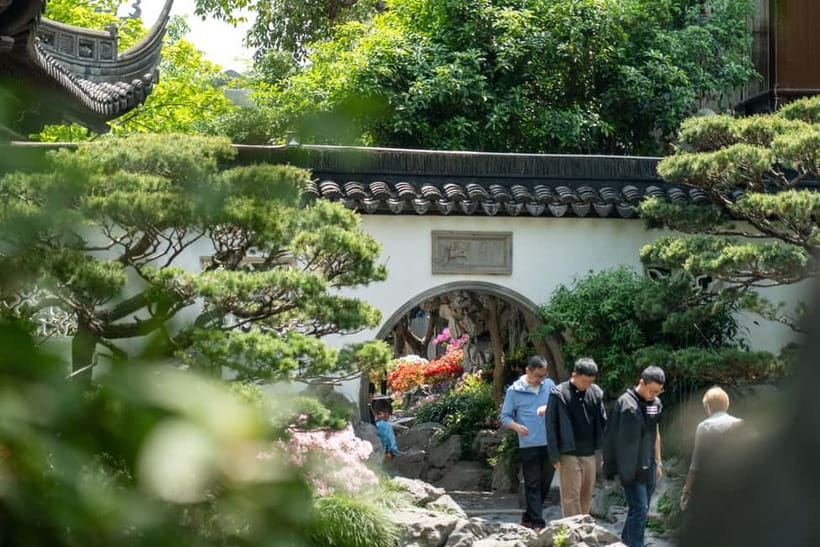
The garden portion includes the scenic 9 Zig-Zag Bridge and the Mid-Lake Pavilion Tea House area. The guided visit here lasts about 20 minutes.
The bridge is a classic garden feature, designed around changing views and movement rather than a straight route from one point to another. Its turns slow your pace and let you see the water, pavilion, rooflines, and garden setting from different angles.
The Mid-Lake Pavilion adds a pause from the street traffic. You will have a chance to look at the traditional garden setting and hear how it fits into the old city. The tea house name is part of the stop, though the supplied details do not promise a tea service or a full tea ceremony, so book this for the views and explanation rather than a tasting.
This section is short. You will not have time to linger over every bridge angle or sit for a long rest. Still, it provides a welcome change of pace after the temple and market streets.
Small goods, local craft, and the market side of Yuyuan
The Yuyuan Garden Smallware area brings you back into the commercial side of the old city. Expect a look at small products, local craftsmanship, and market lanes where you can browse rather than simply pass through.
This stop helps balance the religious and historical parts of the walk. Shanghai’s old city is not only a place of temples and preserved buildings. It is also a place where small shops, souvenirs, food-related businesses, and craft goods meet daily shopping.
The tour does not promise a dedicated street-food tasting, and it is not primarily a shopping tour. I would use this part to notice what catches your eye and return later if you want to buy something. With only about 20 minutes, serious shoppers will need extra time after the tour.
The guide can also help you judge the area more sensibly. Personal recommendations are one of the stated benefits, and the experience is well suited to asking where to spend your next meal, which nearby sights deserve more time, or how to plan the rest of your Shanghai visit.
Ancient City Park provides a quiet finish
The route ends at Shanghai Ancient City Park. After temple courtyards, shop lanes, and the crowded old street, the park gives the walk a calmer final note.
The park is presented as a place where old relics and a peaceful setting meet. That makes it a useful ending rather than an abrupt stop beside a shopping street. You can gather your thoughts, take group photos at attractive landmarks, and decide where to go next.
The finish is also practical. You are not returned to the metro station, so note the ending point before you set a tight schedule. If you need to catch a train, meet friends, or reach a timed attraction, allow extra time for walking from the park.
What the guide adds to the experience
The guide is the main reason to choose this walk over simply visiting Yuyuan on your own. The buildings and temple are easy to find. The harder part is understanding what you are looking at and separating religious practice from decoration, commerce from preservation, and old customs from modern presentation.
The tour is designed around questions and recommendations as much as prepared commentary. The group size allows you to ask about your zodiac animal, temple gods, Chinese medicine, nearby sights, and local food.
Jie is the guide name most closely associated with the experience, though guide assignment can vary. She has led the walk in English and has been praised for clear explanations, cultural awareness, and a personal approach. Some departures have also run longer than the scheduled two hours, but you should plan around the official two-hour duration rather than count on extra time.
The language is English only. If you need a tour in German, French, Italian, or another language, this is not presented as a multilingual departure, even though guides may have worked with people from many countries.
Is $2.36 good value for two hours?
The listed price is about $2.36 per person, which is remarkably low for a two-hour guided walk in a central Shanghai district. But the experience is tip-based, so that figure should not be treated as the complete cost of the guide’s service.
The value is strongest if you use the walk as an introduction. You receive an English-speaking guide, several cultural stops, a small group, group photos, and personal Shanghai suggestions. Even a short explanation can save you time later, especially in a temple district where signs may not explain the meaning of what you see.
The value is weaker if you want long visits, extensive shopping time, a formal tea ceremony, or a detailed Chinese medicine consultation. Those are not what this activity promises.
Free cancellation up to 24 hours before the start gives you some planning flexibility, and you can reserve now and pay later. Check the available departure times before committing, since the exact start time is not fixed in the supplied details.
Who should book this Yuyuan walk?
I would recommend it to first-time Shanghai visitors who want a quick cultural grounding. It suits solo visitors, couples, families, and small groups who enjoy asking questions and walking through busy historic districts.
It is also a good choice if you are curious about Taoism, folk religion, zodiac customs, or traditional Chinese medicine but do not want a specialized lecture. The combination of temple, garden, medicine shop, market, and park gives you several ways into the city’s culture.
The tour is less suitable for anyone with mobility impairments. The route includes walking through old streets, garden paths, temple areas, and market lanes, and there is no indication of adapted access or a slower route.
I would also think twice if you dislike shopping areas or crowded public sites. The walk does not stay in quiet historic spaces. Its character comes from the mix of worship, commerce, gardens, and ordinary city movement.
Should you book it?
Book this tour if you want a low-cost, focused introduction to Shanghai’s old city and value a guide who can explain customs rather than simply point out buildings. The City God Temple, zodiac stories, herb sampling, and garden views give the two hours a clear shape.
Skip it if you need a long, leisurely visit to Yuyuan Garden, a full tea experience, or a specialist medical and religious tour. For most first-time visitors with comfortable shoes and an open schedule, the compact route is a sensible way to get oriented, then return to the places that deserve more time.
FAQ
How long is the Shanghai Ancient City tour?
The tour lasts two hours. The planned stops include 30 minutes at Yuyuan Old Street, 20 minutes at Tonghan Chuntang, 40 minutes at the City God Temple, 20 minutes at the Lake Pavilion Tea House area, and 20 minutes at Yuyuan Garden Smallware.
Where does the tour meet?
The meeting instructions direct you to Yuyuan Garden metro station Exit 1, served by Metro Lines 10 and 14. Look for the red umbrella and use the Chinese address 豫园, 1号出口, 上海市黄浦区. One itinerary detail names Exit 3, so confirm the exit after booking.
Where does the tour finish?
The tour finishes at Shanghai Ancient City Park, written in Chinese as 古城公园. You should allow extra time to continue from the park to your next destination.
Is the tour conducted in English?
Yes. The listed live guide language is English.
How large is the group?
It is a small-group tour limited to 10 participants.
Is the activity suitable for people with mobility impairments?
No. The activity is specifically listed as unsuitable for people with mobility impairments. Comfortable walking shoes are recommended, and you should keep personal belongings secure during the route.
Recently listed in Shanghai
- Private Tour of Shanghai Highlights and Zhujiajiao Water Town in One Day★ 5.0 · 5 reviews
- 4-Hour Private Shanghai Shopping Tour with Local Expert★ 5.0 · 5 reviews
- Shanghai to Beijing Bullet Train Ticket with Hongqiao Station Transfer★ 5.0 · 5 reviews
- Shanghai Hongqiao Airport To Shanghai Hotel:Private transfer with Meet service★ 5.0 · 5 reviews
- Shanghai Coffee & Breakfast Tour★ 5.0 · 5 reviews
- Private Shanghai Hightlight Day Tour with English-speaking Guide★ 4.5 · 5 reviews
- Xitang Water Town Self-Guided Tour from Shanghai with Private Transfer★ 5.0 · 5 reviews
- 4-Hour Private Shanghai Walking Tour of Former French Concession★ 5.0 · 5 reviews
Yu Garden Tours, compared.
Best of Shanghai Day Tour, including Jade Buddha Temple & Bund & Yuyuan Garden
Read our review →
Yu Garden, Old Street, Bund & Zhujiajiao Water Town Bus Tour
Read our review →
Shanghai Day Tour to Zhujiajiao Water Town, Yu Garden, Bazaar, Bund
Read our review →
Private Yu Garden, The Bund, French Concession, Pudong Half-Day Tour
Read our review →


Browse the lists this tour appears in