
Reviewed · BEIJING TOURS
Beijing: Bell and Drum Towers Entry Ticket—Historic Landmark
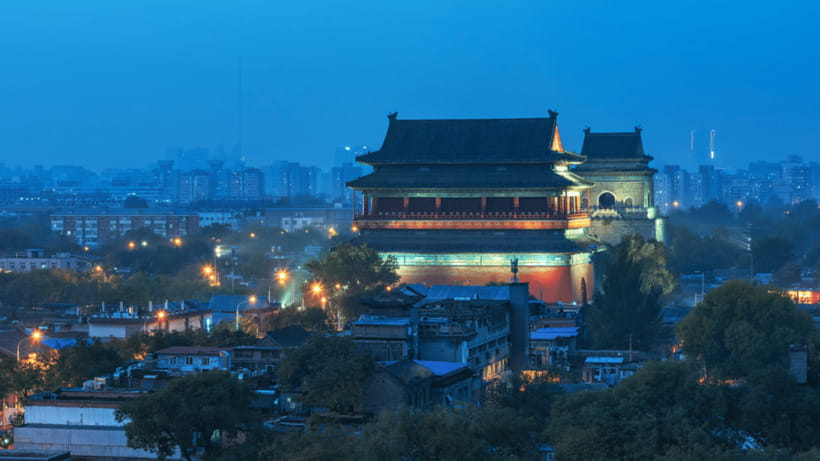
The most memorable part of this visit is the five-minute drum performance at the top of Beijing’s Drum Tower. You climb into the old timekeeping hall, see the great drums up close, and may catch the sharp, rhythmic show that once echoed across the imperial city. The exact time can change, so do not build your whole day around one performance.
I like two things here: you get entry to both towers for about $13, and you can explore without being tied to a group or guide. I also like the contrast between the Drum Tower’s 25 drums and the Bell Tower’s enormous 63-ton bell. The main drawback is simple: this is a self-guided visit, and the PDF guidebook cannot answer questions or lead you through the site in person.
Key points to know before you go
- The Drum Tower may include a five-minute live performance, but the daily time can vary.
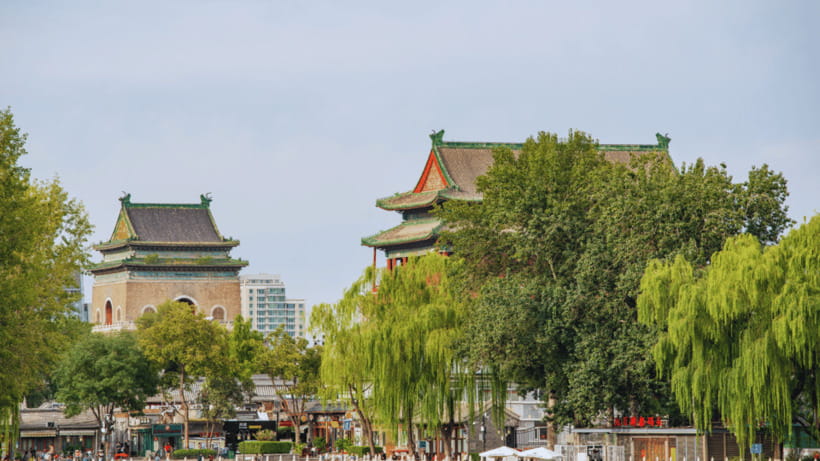
- The Bell Tower holds a 63-ton Yongle-era bell, known as the King of Ancient Bells.
- The Drum Tower once housed 25 drums, giving the imperial city its evening time signal.
- Your ticket covers both towers, with an English PDF guidebook for self-guided exploring.
- The towers sit at the northern end of Beijing’s central axis, making them a useful cultural stop in central Beijing.
- Bring your passport or ID card, and use the free cancellation option if plans change at least 24 hours ahead.
Why Beijing’s old timekeepers still matter

The Bell and Drum Towers are not just two old buildings with large instruments inside. They explain how Beijing once organized daily life before clocks sat on every phone and wall.
Built originally in the Yuan Dynasty, the towers worked as the city’s public clock. The Drum Tower announced dusk with drums, while the Bell Tower marked morning with a bell. This rhythm helped set the pace of the imperial capital, from official work to evening curfews and the start of the next day.
I find that idea more interesting than simply admiring another historic building. You are seeing the machinery of city life in physical form. The sound came from these towers, and the signal reached far beyond the grounds.
The towers occupy an important place at the northern end of Beijing’s central axis. Their north-south arrangement is unusual among old Chinese bell tower complexes, and their design helps show how carefully the imperial city was planned. The protected site covers 12,597 square meters, so allow enough time to look around rather than rushing in for one photograph.
The experience is listed at four hours, though that is best treated as the amount of time available rather than a required schedule. You can use less time for a focused visit or stay longer if you want to read the material, wait for the drum performance, and study the architecture.
More History Tours in Beijing
- Beijing Historical Tour II including Summer Palace, Lama Temple & Panda Garden
★ 4.0 · 187 reviews - Beijing Historical Tour I – Forbidden City, Tiananmen Square & Temple of Heaven
★ 4.0 · 120 reviews - Beijing Historic City Guided Walking Tour + Calligraphy Creation
★ 5.0 · 59 reviews
Climbing the Drum Tower for the drums
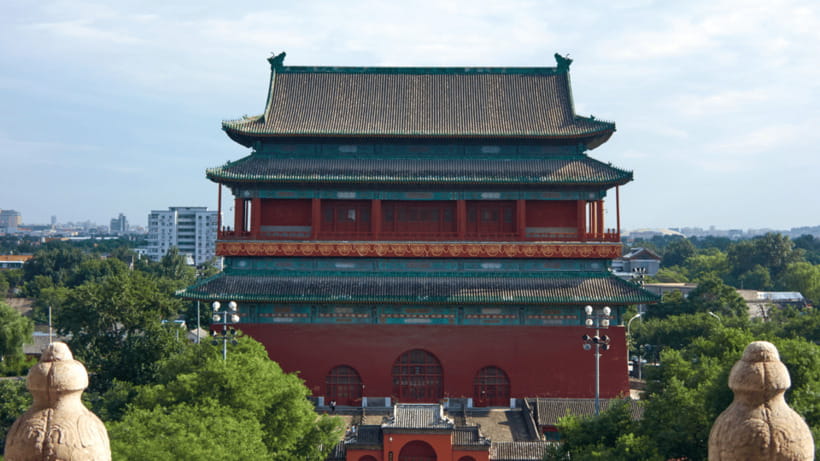
The Drum Tower is likely to be the more active half of the visit. You climb to the upper level, where the historic drums are displayed and where the performance may take place.
The tower once housed 25 drums. These were not small decorative drums. They were powerful timekeeping instruments, built to send a public signal across the city. Seeing them in their original setting gives the display a practical purpose. You can picture the tower as a working civic building, not merely a monument.
The possible performance is the strongest reason to plan your timing carefully. It lasts about five minutes, so it is short but focused. The drumming is meant to be seen and heard as a formal display, not as a long stage show. If you catch it, the visit gains a clear focal point.
The exact performance time depends on the onsite schedule. Check when you arrive, then decide if you want to explore the Drum Tower first or continue to the Bell Tower and return. Since no live guide is included, you will need to manage that timing yourself.
The climb is also part of the experience. The information supplied does not give a precise stair count or accessibility details, so you should be prepared for an elevated historic tower and stairs. If climbing is a concern, confirm the conditions before booking.
From the upper level, you may get a useful look over the surrounding central Beijing area. The available information does not promise a particular view or skyline, so think of the height as an added benefit rather than the main reason to buy the ticket.
The Bell Tower and its 63-ton centerpiece
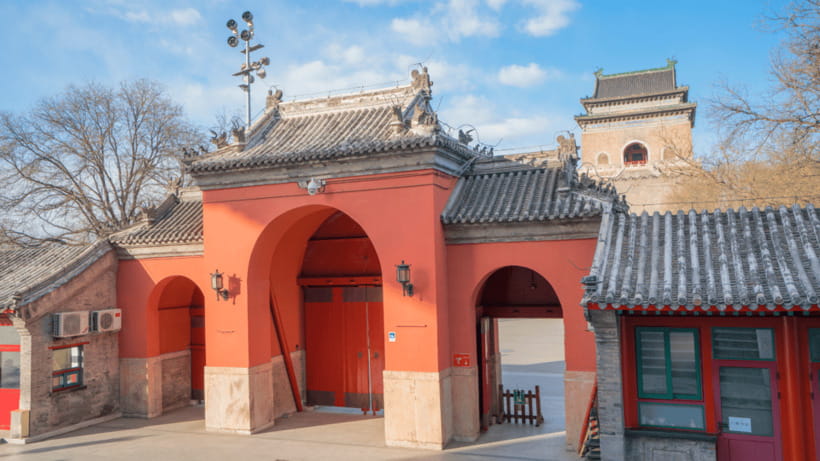
The Bell Tower provides a different mood. Instead of a room filled with multiple drums, you come face to face with one immense bell from the Ming Dynasty’s Yongle era.
The bell weighs 63 tons and is known as the King of Ancient Bells. That scale is hard to grasp from a description alone. Once you see the bell in its setting, its size makes the old timekeeping system feel serious and highly organized. This was not a small bell used for a nearby temple. It represented an official citywide signal.
The bell also reflects the craftsmanship of the imperial period. The towers were designed not only to perform a practical job but also to show authority, order, and technical skill. I like that the visit gives you both sides of this story: the drums create a repeated public rhythm, while the great bell gives the complex a single, commanding centerpiece.
The Bell Tower may take less time than the Drum Tower if you are focused only on the main object. Give it a slower look. Notice the scale of the bell compared with the surrounding structure, and use the PDF guidebook to understand how it fitted into the city’s morning routine.
The ticket allows entry to both towers, so it would be a mistake to see the Bell Tower as an optional extra. The two buildings work best together. One explains dusk, one explains morning, and both show how public time was announced in the imperial capital.
What the English PDF guidebook adds
This is not a guided tour. There is no live guide and no audio guide included. Instead, you receive an English PDF guidebook that provides extra background for a self-guided visit.
That arrangement suits you if you enjoy reading a little, looking closely, and setting your own pace. You can pause at the drums, move on when a section feels complete, and return to a detail without holding up a group.
The guidebook is especially useful because the objects can otherwise seem simple. Without context, you see a tower, several drums, and a giant bell. With context, you understand why the towers existed, how the dusk drum and morning bell system worked, and why their placement mattered.
Do not expect the PDF to replace a personal guide. It will not respond to questions or adjust the explanation to your interests. If you want a specialist to explain architecture, dynastic history, or symbolism in person, this ticket will feel limited.
For an independent visit, though, the format keeps the price down. At about $13 per person, you are paying mainly for access to the two historic buildings rather than a long guided service.
A very different day in Beijing:
- From Beijing: Mutianyu Great Wall Tours with Options
★ 4.9 · 9,216 reviews - Beijing: Forbidden City Tour(Group/Private)-Tickets Included
★ 4.8 · 7,974 reviews - Beijing: T-Square & Forbidden City Group or Private Tour
★ 4.8 · 4,446 reviews - All-Inclusive Tour: Tiananmen Square, Forbidden City, Great Wall
★ 5.0 · 2,873 reviews
How the four-hour visit works in practice
The visit has no fixed group route. You enter the Bell and Drum Towers, explore the rooms and displays, climb the Drum Tower, and decide how long to spend at each part.
A sensible order is to begin at the Drum Tower, since the performance is the one time-sensitive element. Ask about the day’s schedule as soon as you arrive. If the next performance is soon, explore nearby displays first. If it is later, you can visit the Bell Tower and return.
Next, spend time with the 25 drums. Look for the difference between viewing them as museum objects and understanding them as working instruments. Their purpose was tied to the city’s daily schedule, which makes the display more meaningful than a simple collection of large drums.
Then visit the Bell Tower and give yourself time with the 63-ton bell. The contrast between many drums and one huge bell helps explain the separate roles of the two buildings.
The four-hour duration also gives you room for photographs. The towers offer strong architectural subjects, with broad historic forms and large interior instruments. Photography is a natural part of the visit, though the provided information does not specify detailed camera rules onsite.
You should not expect transportation, food, or a guided walk as part of this activity. The value comes from central access, entry to both monuments, and the freedom to explore at your own speed.
The practical side: price, access, and flexibility

At $13 per person, this is a modest cultural ticket by Beijing sightseeing standards. The value is strongest if you already have an interest in old city planning, imperial customs, architecture, or historic instruments.
It is less compelling if you are looking for a full half-day tour with storytelling, transport, and a guide. The price does not include a live guide or audio guide. You receive the PDF guidebook, but the experience depends on your own curiosity.
The central location makes the towers convenient for a day of sightseeing in Beijing. They are at the northern end of the city’s central axis, so you can fit them into a broader visit to historic central Beijing. No specific transport service is included, so you will need to arrange your own way there.
Bring your passport or ID card. The ticket includes entry to both the Bell Tower and Drum Tower, and skip-the-ticket-line access is advertised, which can save some waiting time. Exact starting times should be checked when booking because availability varies.
The booking terms are useful for uncertain plans. You can cancel up to 24 hours in advance for a full refund, and reserve now while paying later. Those options matter in Beijing, where weather, transport, and changing sightseeing plans can affect your day.
Communication appears to be straightforward, with one booking experience noting helpful contact through WhatsApp. Still, do not expect a named personal guide. No guide names are provided because this is an entry ticket rather than a guided tour.
Who will enjoy the towers most

I would recommend this visit to you if you like historic places that explain how ordinary city life once worked. The towers are especially suitable for culture lovers, photographers, and anyone who wants a quieter, self-directed stop in central Beijing.
It is also a good choice if you have already seen Beijing’s major imperial sights and want a different angle on the city. The towers are not another palace complex. They focus on sound, time, civic order, and the daily rhythm of the old capital.
Families with older children may appreciate the large drums and giant bell more than a display made up of small objects and long written panels. The possible performance gives the visit a clear moment of action.
You may want to skip it if you dislike stairs, prefer a guide to explain every detail, or need a fully scheduled tour. The information does not provide accessibility details, so ask before booking if mobility is a concern.
The experience has a current rating of 4.6 out of 5 from 23 recorded bookings. The strongest praise focuses on the drumming, easy ticket use, and smooth communication. One less enthusiastic assessment treated the towers as worthwhile mainly after the rest of Beijing’s major sights were finished. That is a fair way to judge the visit: it is a focused cultural stop, not a complete introduction to Beijing.
Smart ways to get more from the visit

Start by checking the drum performance time. This is the only part of the experience with a schedule that can change, and it is the feature most likely to make the visit feel special.
Read the English PDF guidebook before or during your visit. A few minutes of preparation will help you connect the bell and drums with the old dusk and morning time signals.
Plan to see both towers, even if one seems more appealing at first. The Bell Tower and Drum Tower were designed as a pair, and the contrast between the 63-ton bell and 25 drums is central to the story.
Allow extra time if you want photographs or careful architectural views. The official duration is four hours, but you do not need to stay the full period. Treat it as flexible time rather than a strict program.
Bring your passport or ID card, and keep the ticket information easy to access. The ticket-line benefit is useful, but it does not remove the need to follow onsite entry procedures.
Should you book the Bell and Drum Towers ticket?

Book it if you want an affordable, independent look at one of Beijing’s historic timekeeping complexes, especially if the five-minute drum performance appeals to you. The 63-ton bell and 25 drums give the visit real substance, and entry to both towers makes the $13 price reasonable.
Skip it if you need a live expert, a detailed scheduled tour, or a site with no climbing concerns. For the best experience, check the performance time, read the English PDF guidebook, and treat the towers as a focused history stop rather than a full-day guided outing.
FAQ
What does the Bell and Drum Towers ticket include?
It includes entry to the Bell Tower, entry to the Drum Tower, and an English PDF guidebook for a self-guided visit.
Is a live tour guide included?
No. A live tour guide is not included.
Is an audio guide included?
No. An audio guide is not included. The ticket provides an English PDF guidebook instead.
Can I see a drum performance?
You may see a five-minute drum performance at the top of the Drum Tower. The exact time can vary according to the onsite schedule.
How many drums are in the Drum Tower?
The Drum Tower housed 25 drums.
How heavy is the bell in the Bell Tower?
The Ming Dynasty Yongle-era bell weighs 63 tons.
How long does the activity last?
The stated duration is four hours. You should check availability for the possible starting times.
What should I bring?
Bring your passport or ID card.
Can I cancel the booking?
Yes. You can cancel up to 24 hours in advance for a full refund. Reserve-now, pay-later booking is also available.
Recently listed in Beijing
- Beijing Mutianyu Great Wall Private Tour with Lunch★ 5.0 · 5 reviews
- Customized Private Beijing Layover City Tour★ 5.0 · 5 reviews
- Private Tour to Gubei Water Town and Simatai Great Wall with Cable Car and Lunch★ 5.0 · 5 reviews
- Forbidden City with Hutong Cuisine Private Walking Tour★ 5.0 · 5 reviews
- Beijing Acrobatics Show At Red Theater★ 4.5 · 5 reviews
- Beijing: Top Michelin Vegetarian Restaurant Reservation★ 5.0 · 5 reviews
- Exclusive Private Photography & Video Tour to The Forbidden City★ 5.0 · 5 reviews
- Cuandixia Village Day Trip with Private English Speaking Driver Service★ 4.0 · 5 reviews
Beijing Tours, compared.


Forbidden City Tour(Group/Private)-Tickets Included
Read our review →
T-Square & Forbidden City Group or Private Tour
Read our review →
All-Inclusive Tour: Tiananmen Square, Forbidden City, Great Wall
Read our review →
MuBus: Mutianyu Great Wall ENG/ESP/RUS Guided Bus Tour
Read our review →
4-Hour Small Group Tour to Forbidden City with Entry Tickets
Read our review →

Beijing Full Day Tours: Tiananmen Sq, Forbidden City, Great Wall
Read our review →Browse the lists this tour appears in