
Reviewed · BEIJING TOURS
Beijing Culture: Tea Ceremony, Heritage Instrument & Calligraphy
The most unusual part of this Beijing experience is that you do not simply watch Chinese culture from a polite distance. You brew tea, guide your brush across paper, and place your fingers on the strings of the Guqin, China’s revered ancient instrument. I especially like the small group limit of eight and the calm private setting, two details that keep this from feeling like a stage show. The bilingual guide also adds useful context on Chinese philosophy and history.
I like the way the three activities balance one another: tea slows the pace, music asks you to listen, and calligraphy gives you something tangible to take home. The main drawback is the price, $78.60 per person, which is a serious spend for two and a half hours, and transportation to the venue is not included.
Key points to know before booking
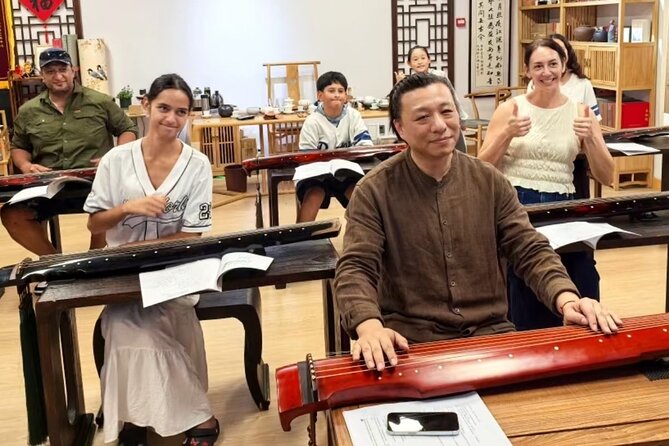
- You play a Guqin melody: A national-level heritage artist performs first, then guides your hands through a full melody.
- The group is capped at eight: Expect personal attention rather than a large cultural demonstration.
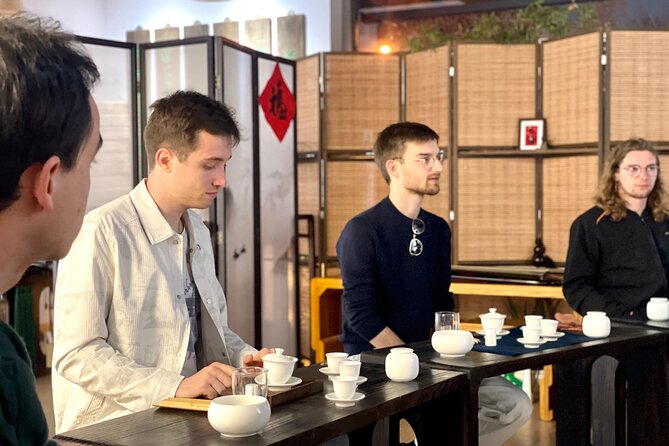
- Tea is part lesson, part ritual: A certified tea master leads brewing and tasting, with tea snacks included.
- Calligraphy has a useful souvenir: You can write meaningful Chinese characters, including your Chinese name, and take the paper with you.
- The venue is a private cultural space: It is located at 813 Creative Park in Chaoyang and is closed to the general public.
- The experience lasts about 2.5 hours: It works best as a focused cultural session, not as a quick stop between major sights.
A quiet cultural pause at 813 Creative Park
Beijing can be tiring. The city’s major sights demand long walks, patient waits, and plenty of attention. This workshop offers a very different rhythm: an air-conditioned cultural venue, a small group, and time to listen before you try anything yourself.
The meeting point is 813 Creative Park, VGP3+CCX, Chaoyang, Beijing 100124. The venue is near public transportation, but you must arrange your own way there. Since transport is not included, leave enough time to reach the address without rushing.
The setting matters. This is not described as a public museum or a performance hall open to passing crowds. It is a private heritage space used by master artists to preserve and teach traditional practices. That gives the session a quieter feel, though you should not expect an enormous collection of objects or a grand sightseeing venue.
A bilingual guide with an M.A. in History and Sociology leads the program in English. The guide’s role is important because each activity has a layer of meaning that is easy to miss if you only learn the physical steps. You will be shown not only what to do, but why the ritual, brushwork, and music matter.
More History Tours in Beijing
- Beijing Historical Tour II including Summer Palace, Lama Temple & Panda Garden
★ 4.0 · 187 reviews - Beijing Historical Tour I – Forbidden City, Tiananmen Square & Temple of Heaven
★ 4.0 · 120 reviews - Beijing Historic City Guided Walking Tour + Calligraphy Creation
★ 5.0 · 59 reviews
Tea with a certified master
The tea portion is more than a welcome drink. A certified tea master leads you through a traditional ceremony, including brewing and tasting. Tea snacks are provided, but this is not a meal, so plan to eat separately if you need lunch or dinner.
I like tea ceremonies when they give you enough time to notice the small actions. The order of pouring, the handling of the cups, and the quiet pauses all become part of the lesson. Here, you are expected to participate rather than sit back and watch the entire process.
That makes the session a good fit if you are curious about Chinese customs but have little prior knowledge. You do not need to arrive with experience in tea preparation or Chinese philosophy. The instruction is designed to make the ritual approachable.
The tea segment also sets the tone for what follows. It is slower than the music and calligraphy portions, and it gives you a chance to settle into the room. If your Beijing schedule has been packed with temples, markets, and traffic, this pause may be just as valuable as the information itself.
The practical limitation is that the exact teas and snacks are not specified. You should view this as a tasting and cultural lesson, not as a full food experience.
Hearing the Guqin before you touch it
The Guqin is the heart of the workshop. A national-level heritage artist gives a live performance, then leads you through a hands-on lesson. You are not expected to become a musician in one afternoon. The goal is to feel how the instrument is played and complete a full melody with guidance.
That distinction makes this more rewarding than a short performance inserted into a sightseeing tour. You first hear the instrument in capable hands, then try to reproduce a melody yourself. The contrast helps you understand both the skill involved and the instrument’s quiet character.
The Guqin is presented here as one of China’s most classical and revered ancient instruments. Even if you know little about Chinese music, you can appreciate the direct connection between the artist, the instrument, and your own hands. The experience gives you a physical memory of the music rather than only a photograph from a concert.
Expect the lesson to be gentle and closely guided. The small group limit of eight should help the artist give individual attention, though the amount of time each person receives may depend on the group and the pace of the session. If you are hoping for a long private music lesson, this is not the right product. If you want a meaningful first encounter, it makes better sense.
This is also the part most likely to appeal to people who dislike standard cultural performances. You are not only watching a skilled artist. You are given a chance to participate in a tradition that can otherwise feel distant.
Calligraphy that gives you something to keep
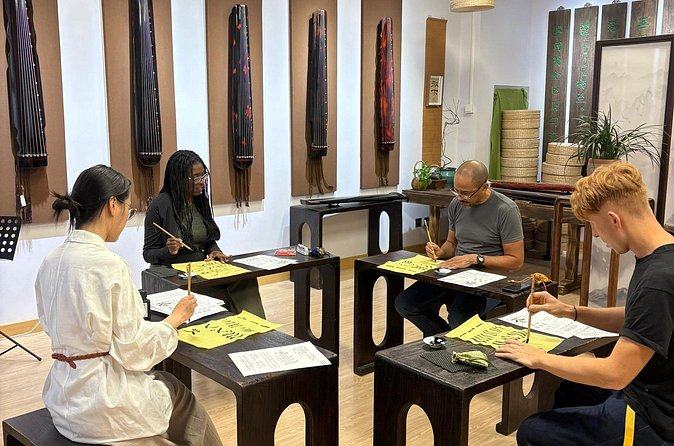
The calligraphy workshop shifts the experience from sound to sight and touch. An expert guides you as you write Chinese characters and learn about their ancient roots. You may also write your Chinese name, creating a personal souvenir rather than receiving a generic item from a shop.
Calligraphy looks simple until you hold the brush. The pressure, angle, and movement all affect the final character. That makes the activity accessible but not effortless. A wobbly first attempt is part of the fun, and the instruction helps you understand why the finished work takes practice.
I like this section because it offers a clear result. You can take your paper home, and it may be worth framing if the final piece turns out well. More important, writing a character gives you a small connection to the shape and structure of the language. You are not expected to read or speak Chinese before joining.
The lesson is also a useful counterpoint to the tea and Guqin. Tea asks you to slow down. Music asks you to listen. Calligraphy asks you to control your movement. Together, the three activities create a well-shaped two-and-a-half-hour program instead of three unrelated demonstrations.
The description does not specify how many characters you will write or how long the calligraphy portion lasts. If you are an experienced brush artist, you may want a more advanced class. For a first introduction, the expert guidance should be enough to make the activity satisfying.
More Tea Ceremonies in Beijing
- Traditional Chinese Tea Ceremony Experience
★ 4.7 · 74 reviews - Chinese Tea ceremony in Beijing Hutong courtyard
★ 4.7 · 26 reviews - Private Beijing Markets Tour with Tea Tasting at Hongqiao Pearl Market
★ 5.0 · 18 reviews - Beijing: Mutianyu Great Wall and Tea House Private Tour
★ 5.0 · 11 reviews
Traditional clothing and the final photo
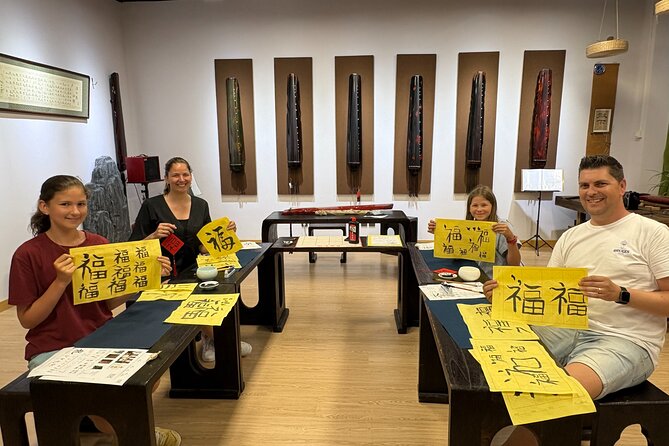
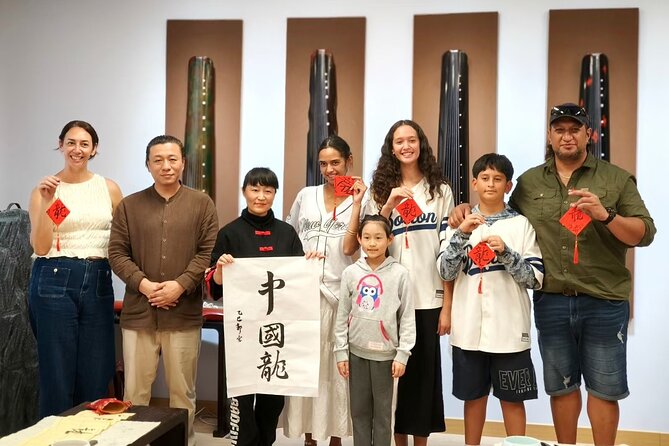
Traditional outfit rental is included for the ritual and photos. This adds a visual element to the session and can make the final group picture more memorable. It also fits the mood of the venue better than arriving in ordinary sightseeing clothes.
Do not treat the clothing as a full costume experience with a large wardrobe selection, since those details are not provided. Think of it as a simple way to take part in the setting and record the day.
The photo is a small detail, but it has practical value. Many cultural activities leave you with only a memory. Here, you can take home calligraphy, and you may also have a group photograph showing the clothing and venue.
Why the small group matters
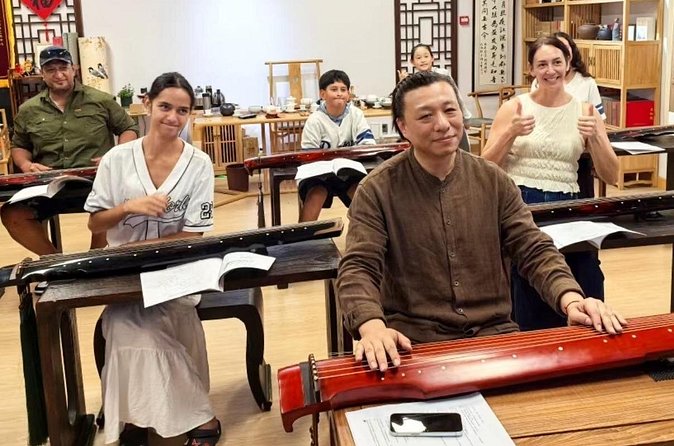
The maximum group size is eight. That is one of the strongest reasons to consider this experience instead of a large cultural show.
With a small group, you have a better chance to ask questions, see the tea preparation clearly, and receive help with the brush and Guqin. The teaching should feel more personal than a demonstration delivered to a room full of people. The program is still shared, so you should not assume every minute will be one-on-one.
The intimate format also suits the subject matter. Tea ceremony and Guqin music lose some of their effect when surrounded by noise and constant movement. A smaller room encourages you to pay attention.
This experience may not suit you if you prefer a fast itinerary or dislike guided hands-on activities. It asks you to sit, listen, follow instructions, and accept that your first brush stroke or musical phrase may not be perfect. That is part of the point.
What the $78.60 price really buys
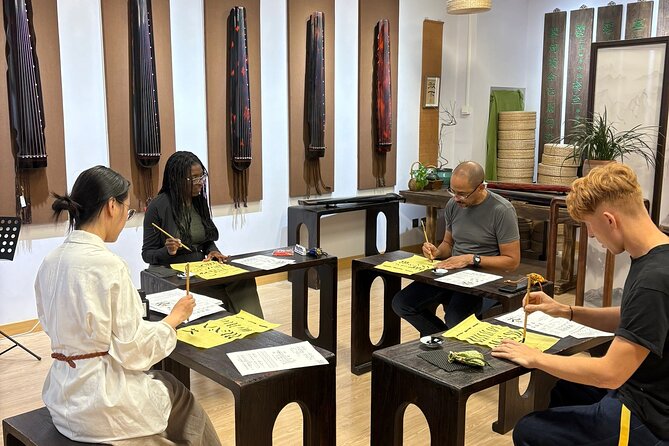
At $78.60 per person, this is not a bargain attraction. You are paying more than you would for a basic museum entrance or a short public performance. The value comes from the combined instruction, the small group, the private venue, and access to national-level cultural practitioners.
The fee includes the tea ceremony and tasting, tea snacks, live Guqin performance, Guqin instruction, calligraphy guidance, traditional clothing rental, and the bilingual guide. It does not include transportation, meals beyond the tea snacks, personal spending, or optional tips.
I would judge the price by asking what kind of Beijing memory you want. If you want maximum sightseeing for the lowest cost, use the money on additional landmarks. If you want an activity that lets you make, play, taste, and learn in one sitting, the price is easier to justify.
The fact that the experience is booked an average of 51 days ahead suggests you should not leave it until the final day of your trip. Availability may be limited, and confirmation is sent within 48 hours of booking, subject to availability. That does not guarantee a date, so check the schedule before building your day around it.
Who will get the most from this experience
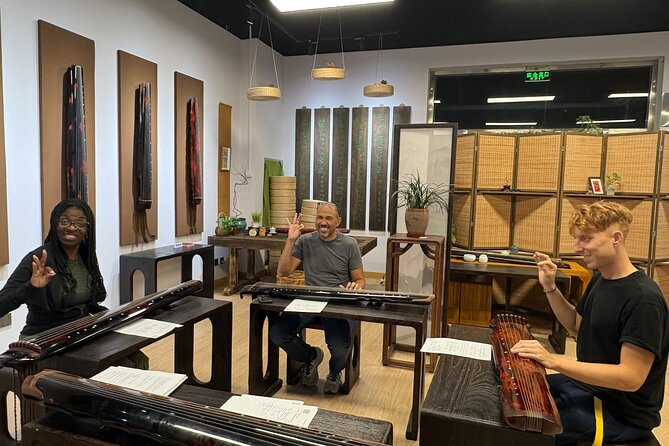
I would recommend it most strongly to:
- First-time visitors who want more than photographs of famous sights
- Couples looking for a quiet cultural activity
- Solo visitors who enjoy learning by doing
- Families with older children who can follow a guided workshop
- People interested in Chinese music, tea, calligraphy, or philosophy
- Anyone tired of large group performances and souvenir-shop stops
It is also suitable for people who already know China well. The session presents living practices through direct contact with artists, so it can offer something different from repeated visits to museums.
The program is less suitable if you need a full meal, hotel pickup, or a completely flexible schedule. It is also not the best choice if you want advanced training in any one subject. The strength is the combination of three traditions in one calm session.
Most people can participate, and service animals are allowed. The activity is near public transportation, but the provided information does not specify the exact route or travel time from central Beijing. Confirm the meeting details after booking and allow extra time for the journey.
Timing, cancellation, and useful planning advice
The session lasts approximately two hours and 30 minutes and ends back at the meeting point. Since transport is not included, avoid scheduling a major timed attraction immediately afterward unless you have a generous cushion.
Free cancellation is available up to 24 hours before the local start time for a full refund. Changes or cancellations inside that 24-hour window are not accepted for a refund. The activity may also be canceled if minimum attendance is not reached or if poor weather affects the operation, in which case you are offered another date or a full refund.
Although the venue is air-conditioned, the experience has a traditional pace. Wear something comfortable enough for sitting and writing. You may be offered traditional attire for the ritual and photos, so clothing that is easy to adjust will make the process simpler.
The tour is mobile-ticket friendly. Keep the ticket available on your phone, and make sure you have the exact meeting point before leaving.
My verdict on this Beijing workshop
I like the balance here. You receive a live performance, but you also play. You taste tea, but you also prepare it. You learn calligraphy, but you also leave with a piece of your own work.
The strongest features are the small group, the peaceful private setting, and the chance to work directly with cultural masters. The experience also avoids the common problem of a cultural activity that explains very little. The bilingual guide connects the actions to Chinese philosophy and history, making the session easier to understand.
The price and lack of included transportation are the clear cautions. You should also book with realistic expectations. This is a first encounter with tea, Guqin, and calligraphy, not an advanced course in any of them.
If you want a calm, personal activity that gives you skills and a keepsake, I think you should book it. If your priority is low cost, major landmarks, or a fast-moving schedule, spend your budget elsewhere.
FAQ
Where does the experience begin?
It begins at 813 Creative Park, VGP3+CCX, Chaoyang, Beijing 100124.
Where does the experience end?
The activity ends back at the meeting point.
How long does the experience last?
It lasts approximately two hours and 30 minutes.
How much does it cost?
The listed price is $78.60 per person.
What is included in the price?
The price includes a traditional tea ceremony and tasting with a certified tea master, a live Guqin performance, a hands-on Guqin lesson, a Chinese calligraphy workshop, traditional outfit rental for ritual and photos, tea snacks, and a bilingual guide with an M.A. in History and Sociology.
Is transportation included?
No. Transportation to and from the venue is not included.
Is food included?
Tea snacks are included. Meals outside of the provided snacks are not included.
How large is the group?
The activity has a maximum of eight participants.
Is the experience conducted in English?
Yes. It includes a bilingual guide, and the workshop is guided in English.
Can I cancel for a refund?
Yes. You can cancel at least 24 hours before the local start time for a full refund. Cancellations or changes made less than 24 hours before the start time are not refunded or accepted.
Recently listed in Beijing
- Beijing Mutianyu Great Wall Private Tour with Lunch★ 5.0 · 5 reviews
- Customized Private Beijing Layover City Tour★ 5.0 · 5 reviews
- Private Tour to Gubei Water Town and Simatai Great Wall with Cable Car and Lunch★ 5.0 · 5 reviews
- Forbidden City with Hutong Cuisine Private Walking Tour★ 5.0 · 5 reviews
- Beijing Acrobatics Show At Red Theater★ 4.5 · 5 reviews
- Beijing: Top Michelin Vegetarian Restaurant Reservation★ 5.0 · 5 reviews
- Exclusive Private Photography & Video Tour to The Forbidden City★ 5.0 · 5 reviews
- Cuandixia Village Day Trip with Private English Speaking Driver Service★ 4.0 · 5 reviews
Beijing Tours, compared.

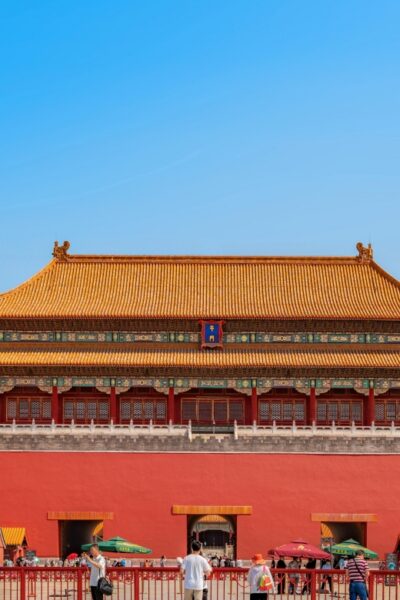
Forbidden City Tour(Group/Private)-Tickets Included
Read our review →
T-Square & Forbidden City Group or Private Tour
Read our review →
All-Inclusive Tour: Tiananmen Square, Forbidden City, Great Wall
Read our review →
MuBus: Mutianyu Great Wall ENG/ESP/RUS Guided Bus Tour
Read our review →
4-Hour Small Group Tour to Forbidden City with Entry Tickets
Read our review →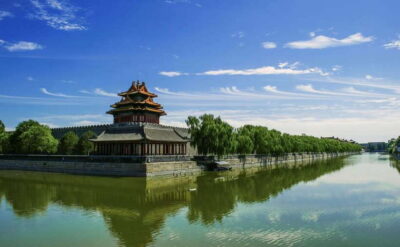
Beijing Full Day Tours: Tiananmen Sq, Forbidden City, Great Wall
Read our review →Browse the lists this tour appears in