
Reviewed · HUTONG TOURS
Discover Old Beijing: Hutong Walking Tour & Calligraphy
Beijing’s old neighborhoods make the city easier to understand on foot. This 3.5-hour walk moves from a historic opera theater through hutongs, markets, Qianmen, and a traditional courtyard, with a short calligraphy lesson along the way. The best part is the mix of famous places and everyday lanes.
I like the local storytelling, especially the way guides such as Shery and Carrie explain how hutongs have changed over time. I also like the hands-on calligraphy stop and the chance to take your artwork home, rather than simply taking photos and moving on. The small snacks and welcome gifts add useful local flavor.
The main thing to consider is the price. The listed cost is $25 per person, but one recent participant described the walk as a tip-based free tour and felt the platform price was high. Confirm how payment works before booking, particularly if you are used to free walking tours.
Key points to know before you go
- A 3.5-hour route through old Beijing: You cover Huguang Guild Theatre, hutongs, Yangmeizhu Byway, Dashilar, Qianmen Street, and a view of Tiananmen Square.
- A real courtyard visit: The route includes a stop inside an authentic hutong courtyard, not just a walk past residential lanes.
- Calligraphy you take home: You create a Chinese calligraphy piece at a local studio at no extra charge.
- Strong local narration: Guides including Shery and Carrie focus on the past, present, and future of Beijing’s hutong districts.
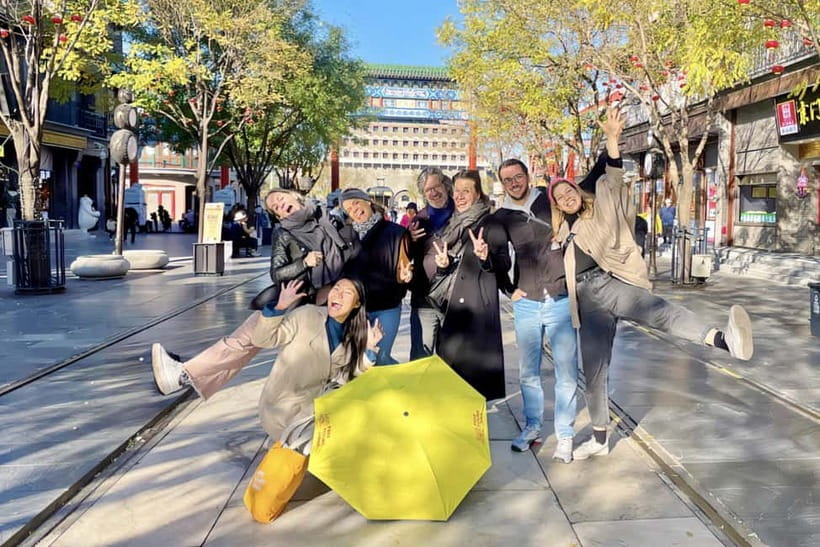
- Easy metro access: Meet at Hufangqiao Station on Line 7, Exit D, then look for the yellow umbrella.
- A city walk with food breaks: Local street snacks and drinks are included, though the exact food may vary.
Why old Beijing makes a good walking tour
Beijing can feel enormous when you first arrive. Wide avenues, grand government buildings, shopping streets, and crowded metro stations compete for your attention. The hutongs offer a different scale: narrow lanes, small courtyards, old shopfronts, and neighborhoods where the city’s past still meets daily life.
This tour gives you a useful introduction to that contrast. You are not spending three hours inside one palace or museum. Instead, you move through several districts and see how Beijing changed from an imperial capital into a modern political center.
I like this format for a first or second day in the city. The guide helps connect places that can otherwise feel separate. An opera theater, an old lane, a cinema, a market street, Qianmen, and Tiananmen Square become parts of one story about urban change.
You should expect plenty of walking and regular stops for explanation. The route is not designed as a quiet stroll through one preserved quarter. It includes commercial areas and major streets, so the experience shifts between residential Beijing and the city’s most visited central sights.
More Walking Tours in Beijing
- Beijing Hutong Walking Food and Beer Tour at Hidden Restaurants
★ 5.0 · 1,132 reviews - Private Beijing Walking Tour of the Forbidden City with 7 Options
★ 5.0 · 675 reviews - Forbidden City Private Walking Tour with Optional Sights
★ 5.0 · 400 reviews
Starting at Huguang Guild Theatre
The meeting point is Hufangqiao Metro Station on Line 7, Exit D, the southwest exit. After leaving the station, walk toward the main road, turn right, and continue about 60 meters east to the green space near the intersection of Hufang Road and Luomashi Avenue.
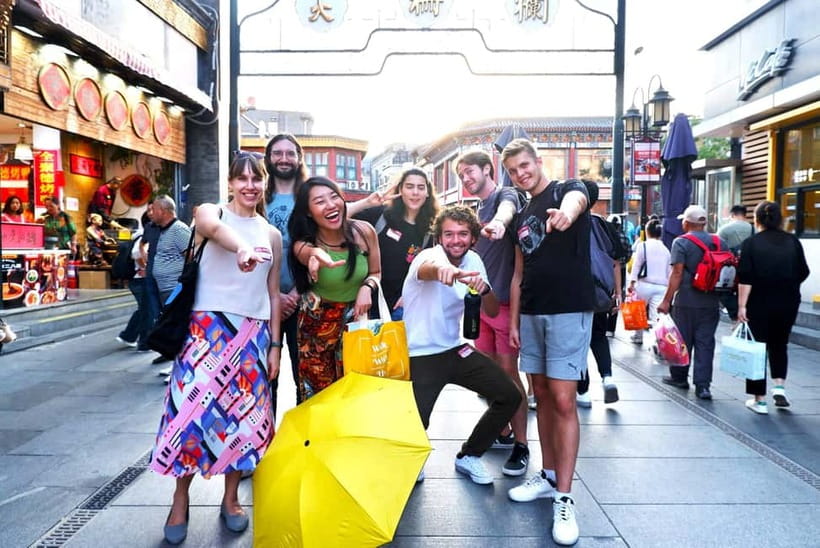
The Huguang Guild Theatre is the nearby landmark. Look for the yellow umbrella at the green space. This detail matters because Beijing’s metro stations are large, and a wrong exit can put you on the wrong side of a busy road.
Arrive five to ten minutes early. The guide may wait up to 20 minutes while giving the opening talk, but the walk cannot be held for late arrivals. Google Maps is not dependable in China, so use the written directions rather than relying on a map pin.
The tour begins at Huguang Guild Opera Theatre with about 30 minutes of guided explanation. The building gives the outing a strong opening because it introduces Beijing’s performing arts and old civic institutions before you enter the lanes.
From opera traditions to Beijing hutongs
The first hutong section lasts about 30 minutes. Here, the guide’s value is more than pointing out old walls. You learn how these lanes functioned as neighborhoods and how residents have adapted as Beijing expanded and redevelopment changed many traditional districts.
Carrie, one of the named guides, has been praised for explaining the past, present, and future planning of the hutongs. That focus is helpful because the old lanes are not simply frozen pieces of history. They are part of a living city facing pressure from traffic, housing needs, tourism, and modernization.
You may notice that the word hutong covers a range of streets and alleys. Some feel residential, while others have shops, food stalls, or tourist traffic. The guide can help you see the difference between a photo opportunity and a functioning neighborhood.
A possible limitation is that the experience cannot provide a long visit inside every courtyard. The route moves at a steady pace, so you get an overview rather than a detailed architectural study.
The courtyard stop and calligraphy session
The secret stop is one of the most appealing parts of the walk. You visit an authentic hutong courtyard for about 20 minutes, giving you a look beyond the public street.
This is valuable because a lane tells only part of the story. The courtyard layout helps you understand how old Beijing homes were arranged around shared or private central spaces. The visit is short, but it adds a sense of place that a normal street walk cannot provide.
The calligraphy activity takes place at a local studio. You create your own Chinese calligraphy artwork and take it home. I like this more than a standard souvenir stop because you take part in a cultural practice and leave with something personal.
You should not expect an advanced art class in a short city walk. The point is to try the brush, learn a little about the form, and make a keepsake. If you are concerned about producing perfect characters, relax. This is an introduction, not an examination.
The calligraphy session also gives the group a change of pace. After walking through lanes and listening to urban stories, you have time to sit, concentrate, and make something with your hands.
More hutong walks:
- Temple Heaven, Summer Palace, Lama Temple, Hutong Bus Tour
★ 4.7 · 319 reviews - Temple of Heaven, Summer Palace, Lama Temple, Hutong Tours
★ 5.0 · 311 reviews - Beijing Private Hutong Food Walking Tour
★ 5.0 · 299 reviews - The Hutong Experience by Bike
★ 5.0 · 163 reviews
Yangmeizhu Byway and the changing hutong scene
The tour then reaches Yangmeizhu Byway, with about 30 minutes of guided walking. This area is known for its older street character and its mix of local life, small businesses, and creative spaces.
The byway helps show how Beijing’s traditional districts are being used today. You might find old residential features beside newer shops and visitor-oriented businesses. That contrast is part of the appeal, but it also means the street may feel less purely residential than you expect.
The guide’s explanation is important here. Without context, you could simply see a narrow street with attractive doors and signs. With a good storyteller, you get a better idea of how the area fits into Beijing’s wider changes.
This portion is also useful for photos, but remember that the walk is a group activity. You will have time for pictures, though not unlimited time at every doorway or storefront.
Daguanlou Cinema and the birthplace of Chinese cinema
Daguanlou Cinema receives about 20 minutes of attention. The stop connects the neighborhood walk with the history of Chinese film.
Calling it the birthplace of Chinese cinema gives the stop a clear cultural role. It shows that old Beijing was not only a place of imperial institutions and traditional homes. It also became an early center for modern entertainment and public culture.
For film fans, this may be one of the most distinctive points on the route. For everyone else, it breaks up the architectural focus and adds another way to understand the city’s development.
The visit is presented as a guided stop rather than a long screening or museum session. Keep your expectations in line with that. You are learning why the cinema matters, not spending an afternoon watching films.
Dashilar Residential District and local street food
Next comes the Dashilar residential district, where the tour spends about 30 minutes. Dashilar is one of central Beijing’s best-known old commercial areas, and it gives you a closer look at the relationship between shopping streets and nearby homes.
The route also includes a snack break with local street food and drinks. This is a practical inclusion. A three-and-a-half-hour walk is easier when you have a small pause, and food gives the guide another way to explain ordinary habits and neighborhood life.
The exact snacks are not specified, so you should not book this expecting a particular dish. Think of it as a chance to taste something local during the walk. If you have food allergies or strict dietary needs, ask the provider before booking.
Dashilar can be busy and commercial. That is not necessarily a flaw, since the area shows how old districts attract both local shoppers and sightseers. Still, you should expect a livelier street scene here than in the quieter residential lanes.
Qianmen Street and Zhengyang Gate
The final major section takes about 40 minutes around Qianmen Pedestrian Street. This is the longest stop on the route and brings together shops, historic gateways, public space, and Beijing’s central visitor zone.
You also see Zhengyang Gate and its Arrow Tower. These structures help explain the old city’s defensive layout and the importance of the southern approach to the imperial center.
Qianmen is not a hidden residential lane. It is a major pedestrian shopping street, with restored architecture and a strong tourism role. I would not visit expecting untouched old Beijing. Instead, use it as a place to see how the city presents its past in a busy modern setting.
The route also includes the narrowest hutong in Beijing. A stop like this works best as a quick visual lesson. You see how compact the old street network could be, then compare it with the broad avenues and open public spaces nearby.
Seeing Tiananmen Square from outside
Tiananmen Square is viewed from outside rather than entered as a dedicated square visit. That distinction matters. The tour gives you a look toward one of Beijing’s most important public spaces, but it does not promise an extended visit inside.
For a short walking tour, this is a sensible way to include the square without making it the entire focus. You get the setting and the chance for photos while keeping the attention on hutongs, neighborhoods, and local culture.
You should treat this as an exterior viewpoint, not a full Tiananmen sightseeing session. If the square is a top priority, set aside separate time and check current entry and security requirements independently.
What the guide adds to the experience
The guide is the key factor in this tour. The route includes places you can partly see on your own, but the explanations give them purpose.
The strongest guide style here is conversational and locally focused. Shery is described as friendly and clear, while Carrie has been singled out for explaining how hutong planning has changed across different periods. The experience also promises stories from people who have lived through change in the old neighborhoods.
That local perspective can help you avoid a postcard-only view of Beijing. You hear about survival, redevelopment, and the effort to balance old homes with modern needs. The tour is not just a list of dates and buildings.
The experience is in English. Since the group meets fellow participants from different countries, it can also work well if you want an easy way to meet people during your first days in Beijing.
Is $25 good value?
At $25 per person, the price is reasonable if you value a guide, a planned route, snacks, the courtyard visit, and the calligraphy activity. The walk covers a lot in 3.5 hours, and the calligraphy artwork gives you a physical souvenir without another purchase.
The value is less clear if you mainly want independent sightseeing. Several stops are public streets that you could visit without paying, and one participant understood the experience as a tip-based free walking tour. That creates an important point to clarify before you reserve.
I would compare the price with what is included, not just the number of sights. You are paying for the guide’s time, the route design, the courtyard access, the studio activity, and the convenience of moving through several central areas in one morning or afternoon.
The provider has operated since 2017 and says it has led more than 2,400 tours for over 38,000 people. That suggests an established operation, though the rating is 4.3 from 24 posted ratings, so I would keep expectations realistic rather than treating the tour as flawless.
Who should book this Beijing walk?
I would recommend it to first-time visitors who want a broad introduction to central Beijing without spending a full day in a bus or museum. It suits people who enjoy walking, short historical talks, street scenes, and hands-on activities.
It is also a good fit if you want help getting oriented. After this route, you should have a clearer sense of how Qianmen, Dashilar, the hutongs, and the southern approach to the imperial center relate to one another.
Families with older children may enjoy the calligraphy and snack break, though the amount of walking should be considered. Art-minded visitors will find the calligraphy stop especially worthwhile, while film fans may appreciate the Daguanlou Cinema connection.
I would be more cautious if you dislike group tours, cannot walk for several hours, or want a slow architectural study. The program includes many stops, so the pace is active. It also mixes preserved areas with commercial streets rather than offering a quiet, untouched old quarter.
Practical advice for a smoother outing
Wear comfortable shoes. The route is on foot for 3.5 hours, and Beijing’s large streets and metro stations can make the journey feel longer than the distance suggests.
Arrive early and save the meeting instructions offline. Use Hufangqiao Station, Exit D, walk about 60 meters east, and find the yellow umbrella near the green space by Huguang Guild Theatre.
Bring water and keep your schedule flexible around the start. Heavy traffic and the size of the metro station are specifically noted as possible causes of delay.
You can cancel up to 24 hours before the activity for a full refund, and the reserve-now, pay-later option keeps you from paying at once. Starting times vary, so check the available date and time before you finalize your plans.
Should you book Discover Old Beijing?
Book this tour if you want a lively introduction to old Beijing with a local English-speaking guide, a courtyard visit, street food, and a calligraphy keepsake. The strongest reasons to choose it are the varied route and the chance to hear how hutong life is changing from guides such as Shery and Carrie.
Think twice if the $25 price feels high for a walk that may operate partly on tips. Confirm the payment arrangement first. If that point is clear and you like a steady walking pace, this is a useful way to connect Beijing’s narrow lanes with its grand central streets in one well-packed outing.
FAQ
How long does the hutong and calligraphy tour last?
The tour lasts 3.5 hours, including the guided stops, courtyard visit, calligraphy activity, snack breaks, and walking between areas.
Where is the meeting point?
Meet at Hufangqiao Metro Station on Line 7, Exit D, the southwest exit. Walk toward the main road, turn right, and continue about 60 meters east to the green space near Hufang Road and Luomashi Avenue.
How do I find the guide at the meeting point?
Look for the yellow umbrella at the green space beside Huguang Guild Opera Theatre. Arrive five to ten minutes early because the guide cannot delay the tour for late arrivals.
Is the tour conducted in English?
Yes. The activity includes a live English-speaking local guide.
What is included in the price?
The tour includes the local English-speaking guide, welcome gifts, a China survival guide, local street food and drinks during snack breaks, the courtyard visit, and the Chinese calligraphy activity.
Can I cancel the booking?
You can cancel up to 24 hours in advance for a full refund. A reserve-now, pay-later option is also available.
Recently listed in Beijing
- Beijing Mutianyu Great Wall Private Tour with Lunch★ 5.0 · 5 reviews
- Customized Private Beijing Layover City Tour★ 5.0 · 5 reviews
- Private Tour to Gubei Water Town and Simatai Great Wall with Cable Car and Lunch★ 5.0 · 5 reviews
- Forbidden City with Hutong Cuisine Private Walking Tour★ 5.0 · 5 reviews
- Beijing Acrobatics Show At Red Theater★ 4.5 · 5 reviews
- Beijing: Top Michelin Vegetarian Restaurant Reservation★ 5.0 · 5 reviews
- Exclusive Private Photography & Video Tour to The Forbidden City★ 5.0 · 5 reviews
- Cuandixia Village Day Trip with Private English Speaking Driver Service★ 4.0 · 5 reviews
Hutong Tours, compared.
Beijing Hutong Walking Food and Beer Tour at Hidden Restaurants
Read our review →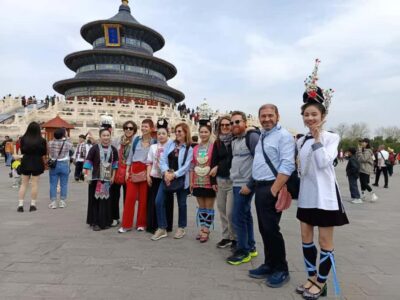
Temple Heaven, Summer Palace, Lama Temple, Hutong Bus Tour
Read our review →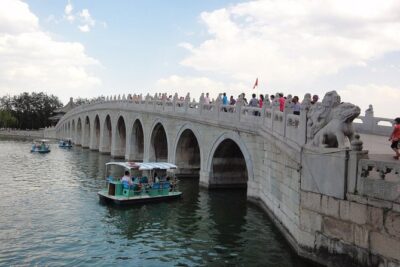
Temple of Heaven, Summer Palace, Lama Temple, Hutong Tours
Read our review →



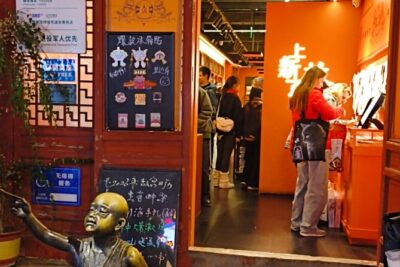
Beijing City Walk: Explore Hutongs Life and Old Beijing
Read our review →Browse the lists this tour appears in