
Reviewed · BEIJING TOURS
China’s Favourite Street Food Cooking Workshop
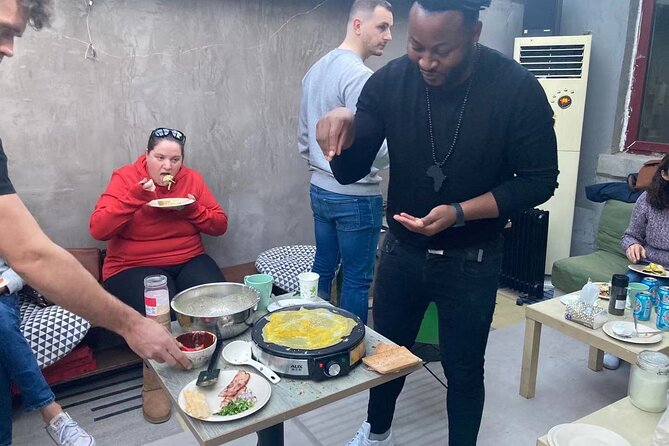
Beijing’s jian bing is usually a quick breakfast from a street cart. Here, you slow the process down and learn how the thin batter becomes a crisp, folded meal. I like the hands-on format, since you make the dough and cook it yourself rather than simply watching. I also like the private setup, which gives Dom time to help your group through the tricky first attempts.
The workshop is especially good for families and groups of friends. Dom adds the food’s background before getting to work, and the fillings range from traditional savory choices to chocolate and banana. The main consideration is time: at about 90 minutes, this is a compact food activity, not a full cooking course or broad survey of Beijing cuisine.
Key points to know before booking
- You cook the jian bing yourself: You handle the batter and pan with direct help from the instructor.
- Dom leads the class: He explains the food’s background and helps you improve your technique.
- Savory and sweet fillings are available: You can try familiar street-food combinations or make a dessert-style version.
- The class is private: Only you and your party take part, so the pace can suit your group.
- It works well with children: Families and groups of middle-school-aged children have used it as a relaxed daytime activity.
- The meeting point is in Dongcheng: Start and finish at 10 Shi Que Hu Tong, with the activity lasting about 1 hour and 30 minutes.
Jian bing turns a Beijing street snack into a cooking lesson
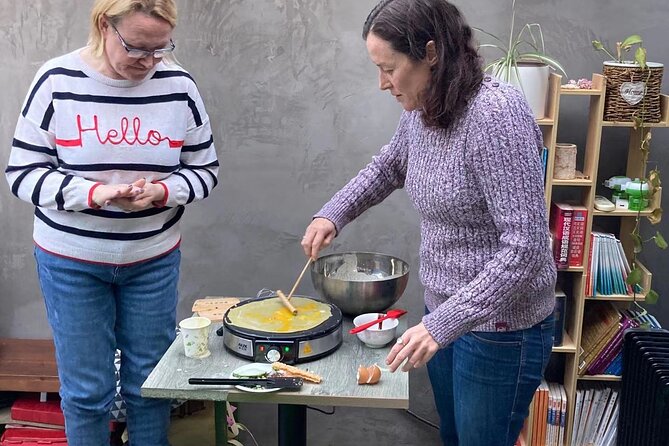
Jian bing is one of those foods that makes a city feel practical and lived-in. It is quick, filling, inexpensive, and made in front of you. A vendor spreads batter across a hot surface, adds an egg and fillings, folds the whole thing into a crisp package, and passes it over the counter.
This workshop lets you see that process from the other side. Instead of standing at a cart and trying to guess how the cook controls the batter, you get a chance to make your own. You learn through repetition, which matters because the first attempt may not spread perfectly.
That trial-and-error element is part of the appeal. You are not being asked to produce a polished restaurant dish on your first try. You are learning how thin the batter should be, how to work it across the pan, and when to add the fillings. The instructor remains available when you need help.
I like this approach because it connects food with daily life in Beijing. You are not only tasting something local. You are learning why the dish works as street food and what makes its texture and folding technique distinctive.
More Cooking Classes in Beijing
Starting with the story behind Beijing’s favorite street food
The session begins with an explanation of where jian bing comes from and why it has such a strong place in Beijing’s food culture. Dom presents this part as an entertaining story rather than a formal lecture, which keeps the opening easy to follow.
That short introduction gives the cooking a useful frame. Once you know you are working with a popular street-food staple, the technique feels less like an abstract kitchen exercise. You understand what you are trying to recreate: a fast, adaptable meal that can change according to the fillings.
The historical introduction is also a good fit for visitors who have already eaten jian bing at a street cart. You may recognize the shape and flavors, but the class shows you the work behind them. For people living in Beijing, it can add a new angle to a food they already know well.
Do not expect a long academic account of Chinese food history. The emphasis is on getting you ready to cook. That is the right balance for a 90-minute activity, especially if you are looking for something active rather than another guided talk.
Making the batter and learning the hard part
After the introduction, you move into the practical work. The class includes making the batter or dough and learning how to handle it on the cooking surface. This is where the activity earns its value.
Jian bing looks simple when an experienced vendor makes it. Spreading a thin, even layer takes more control than you might expect. You have to work quickly enough to shape the batter while it is still workable, but carefully enough to avoid leaving thick patches or gaps.
The good news is that you can try more than once. The class is not built around making one perfect item and leaving. You have room to adjust your method, and Dom can step in when the batter is not behaving as planned.
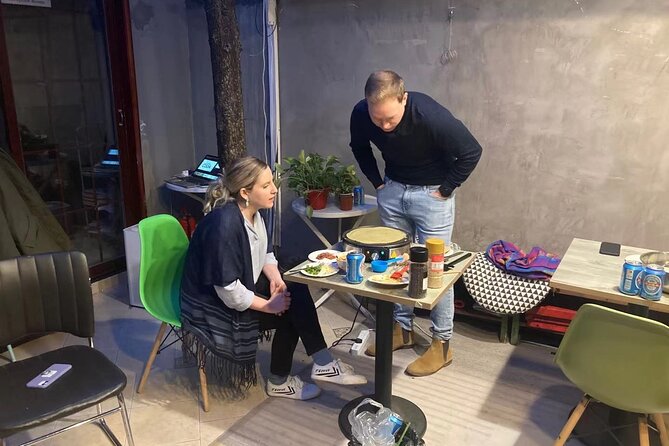
That private format matters here. In a large class, you might spend much of the time waiting for a turn or watching someone else use the pan. With only your party involved, the attention stays on your group. You can ask questions, repeat a step, and move at a pace that suits your cooking confidence.
The experience is friendly to beginners. You do not need professional kitchen skills, and the purpose is not to test you. Still, you should expect to participate fully. This is not a demonstration where the instructor does all the work while you take photographs.
Cooking your own creation on the pan
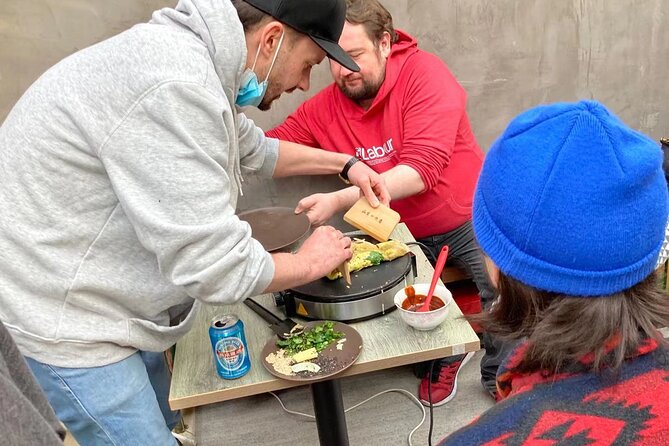
The most satisfying part is cooking the jian bing yourself. You get to work with the pan and see the dish change in front of you. Batter becomes a thin base, fillings are added, and the finished food is folded into something you can eat by hand.
This hands-on step gives you a better sense of the food than simply tasting one prepared for you. You notice the texture, the timing, and the small choices that affect the result. A thinner spread may produce a different bite from a thicker one, and the amount of filling affects how easily the jian bing folds.
You may need a few attempts before the technique feels natural. That is not a flaw in the experience. In fact, it is one of the reasons the class works. Each attempt gives you a chance to make a small correction.
The class also gives you the freedom to make as many jian bings as you want within the session, according to the experience details provided by past participants. That makes the activity feel generous rather than tightly scripted. You are not rushed through one turn before the class moves on.
If you are cooking with friends, this becomes a low-pressure group activity. You can compare results, try different fillings, and laugh at the less-than-perfect folds. Families can split the work as well, with children taking part under the instructor’s guidance.
More Food Tours in Beijing
- Beijing Hutong Walking Food and Beer Tour at Hidden Restaurants
★ 5.0 · 1,132 reviews - Beijing: Hidden Gems Guided Food Tour with Beer and Tastings
★ 4.9 · 306 reviews - Beijing Private Hutong Food Walking Tour
★ 5.0 · 299 reviews - Beijing Hutong Breakfast Food Tour
★ 5.0 · 155 reviews
Choosing fillings, from traditional savory to chocolate and banana
The fillings are where the workshop becomes personal. You can try traditional savory flavors, then make a sweeter version if that suits your group. Chocolate and banana are specifically available among the possible choices, giving the class a playful change from the usual street-food style.
This variety is useful because not everyone wants the same flavor. One person may prefer a familiar savory jian bing, while another may want to experiment. You can also see how a basic cooking method adapts to different tastes.
The sweet option should not be confused with the classic version sold from Beijing carts. It is more of a creative variation, but that is part of the fun. The workshop encourages you to make the food your own rather than treating one recipe as fixed.
For children, the choice of fillings can make the session easier to enjoy. A child who is cautious about unfamiliar savory ingredients may be more interested in chocolate and banana. Adults can use the class to compare traditional and modern combinations.
Some participants have also received ingredients to take home. This is not presented as a guaranteed part of every booking, so I would treat it as a possible extra rather than a promise. The more important takeaway is the method, which you can use again once you return home.
Why the private format makes a difference
This is a private activity for you and your party only. That gives it a more personal feel than a standard group cooking class and lets the instructor focus on your needs.
A private class is particularly helpful for mixed-age groups. Parents can let children take part without worrying about holding up strangers, while adults can ask for more help with the batter or cooking technique. A group of friends can also spend more time choosing fillings and trying different versions.
The private format can come with a higher price than a shared class. At $80, the value depends partly on the size of your party. For one person, that is a fairly high cost for a 90-minute food activity. For several people sharing the private experience, the price becomes easier to justify because you are paying for personal instruction and a shared activity.
I would compare it with the cost of several ordinary meals, but that is not the whole calculation. You are also paying for an instructor, kitchen access, the ingredients, and a memorable activity in central Beijing. If you mainly want a cheap snack, a street cart is the better choice. If you want to learn and cook with your family or friends, the price makes more sense.
A good match for families, friends, and Beijing residents
The class has a broad appeal, but it is strongest for a few types of visitors.
Families get a simple activity with an edible result. The session has enough action to keep children involved, and the sweet fillings provide an easy option for younger participants. The experience has also been used for middle-school-aged children and their parents during the Chinese New Year holiday.
Groups of friends can treat it as a relaxed daytime outing. You are working together, but the activity is not demanding or competitive. It can fit nicely between sightseeing stops, especially if you want a break from museums, temples, and busy shopping streets.
People who already live in Beijing may find it just as worthwhile as first-time visitors. If you have eaten jian bing for years, learning to make it gives you a fresh connection to a familiar food. It can also help replace that favorite local breakfast when you leave the city, though the exact ingredients available at home may differ.
I would be less likely to choose it if you want a serious chef-led course with several dishes. The session focuses on one street food, and its strength is the relaxed, practical format rather than culinary breadth.
Getting to 10 Shi Que Hu Tong in Dongcheng
The meeting point is 10 Shi Que Hu Tong, Dongcheng District, Beijing, postal code 100010. The activity ends at the same place, so you do not need to arrange a separate return transfer.
The location is near public transportation, which should help you build the class into a day of sightseeing. You will still want to allow time to find the exact address, since hutong locations can be less straightforward than a large hotel or major attraction. Your mobile ticket is useful for keeping the booking details at hand.
The class lasts about 1 hour and 30 minutes. That makes it easy to schedule in a morning or afternoon, but you should allow extra time before the start in case you need to find the meeting point. The activity itself is short enough for children and relaxed enough for a group break.
The experience is described as a return-to-meeting-point activity rather than a tour through several parts of Beijing. You are going to one place to cook, not combining the class with a long hutong walk or a wider city tour.
What the experience does especially well
The strongest part is the balance between explanation and action. Dom gives you context, then gets you cooking. You are not left to guess at the method, but you also do not spend the whole session watching a demonstration.
The second strength is the range of fillings. Traditional savory choices keep the class connected to Beijing street food, while chocolate and banana add a fun option for children and adventurous cooks.
The third is the atmosphere. The activity is described as relaxed and good for groups, with enough time to make several attempts. That makes it more forgiving than a tightly timed cooking lesson.
Finally, it has a clear sense of place. Jian bing is not an imported recipe selected at random for tourists. It is a food associated with everyday Beijing, and the class helps you understand it through your own hands.
Practical details before you reserve
Confirmation arrives within 48 hours of booking, subject to availability. That means you should not assume your place is final until the confirmation comes through.
Service animals are allowed, and the location is near public transportation. The class is private, so only your own group takes part. If you have particular dietary needs or questions about the available fillings, ask before booking because the supplied details do not specify a full allergy or dietary menu.
Free cancellation is available if you cancel at least 24 hours before the local start time. Cancellations made less than 24 hours ahead are not refunded, and changes inside that window are not accepted. Keep the local time in mind when making changes from another country.
Should you book the jian bing workshop?
I would book this if you want a hands-on taste of everyday Beijing, especially with children, friends, or family. The private setting, Dom’s clear instruction, repeated attempts at the pan, and mix of savory and sweet fillings make it more than a quick snack stop.
I would skip it if your main goal is maximum sightseeing time or a broad Chinese cooking course. At $80, it is best value when shared by a group that wants a relaxed activity and plans to eat what it makes.
For most food-minded visitors, this is a smart break from the usual Beijing sightseeing list. You leave with a full belly, a better understanding of jian bing, and at least a chance of recreating the dish at home.
FAQ
How long does the jian bing workshop last?
The activity lasts approximately 1 hour and 30 minutes.
Where does the experience begin?
It begins at 10 Shi Que Hu Tong, Dong Cheng Qu, Beijing, China, 100010.
Where does the experience end?
The activity ends back at the meeting point.
Is this a private class?
Yes. Only you and your party participate in the activity.
Will I make the jian bing myself?
Yes. The workshop includes hands-on instruction, and you make the batter or dough and cook your own jian bing on the pan with help from the instructor.
Are both savory and sweet fillings available?
Yes. The available choices include traditional savory fillings as well as sweet combinations such as chocolate and banana.
Can I cancel for a full refund?
Yes, if you cancel at least 24 hours before the experience start time. Cancellations made less than 24 hours before the start are not refunded.
More workshops and classes in Beijing
- Beijing Calligraphy Class
★ 4.9 · 112 reviews - Chinese Calligraphy Class for Small Group
★ 5.0 · 104 reviews - Beijing: Dumpling Making Workshop with Meal and Tea
★ 4.7 · 69 reviews - Beijing Wangfujing Calligraphy Class by Forbidden City
★ 5.0 · 58 reviews
Recently listed in Beijing
- Beijing Mutianyu Great Wall Private Tour with Lunch★ 5.0 · 5 reviews
- Customized Private Beijing Layover City Tour★ 5.0 · 5 reviews
- Private Tour to Gubei Water Town and Simatai Great Wall with Cable Car and Lunch★ 5.0 · 5 reviews
- Forbidden City with Hutong Cuisine Private Walking Tour★ 5.0 · 5 reviews
- Beijing Acrobatics Show At Red Theater★ 4.5 · 5 reviews
- Beijing: Top Michelin Vegetarian Restaurant Reservation★ 5.0 · 5 reviews
- Exclusive Private Photography & Video Tour to The Forbidden City★ 5.0 · 5 reviews
- Cuandixia Village Day Trip with Private English Speaking Driver Service★ 4.0 · 5 reviews
Beijing Tours, compared.
Forbidden City Tour(Group/Private)-Tickets Included
Read our review →
T-Square & Forbidden City Group or Private Tour
Read our review →
All-Inclusive Tour: Tiananmen Square, Forbidden City, Great Wall
Read our review →
MuBus: Mutianyu Great Wall ENG/ESP/RUS Guided Bus Tour
Read our review →
4-Hour Small Group Tour to Forbidden City with Entry Tickets
Read our review →

Beijing Full Day Tours: Tiananmen Sq, Forbidden City, Great Wall
Read our review →Browse the lists this tour appears in